Creator Platform Rule Changes: A Live Timeline
Last updated: 4 September 2026. Every date and figure below comes from the platform’s own announcement or documentation, linked at the bottom. This page is kept current as rules change.
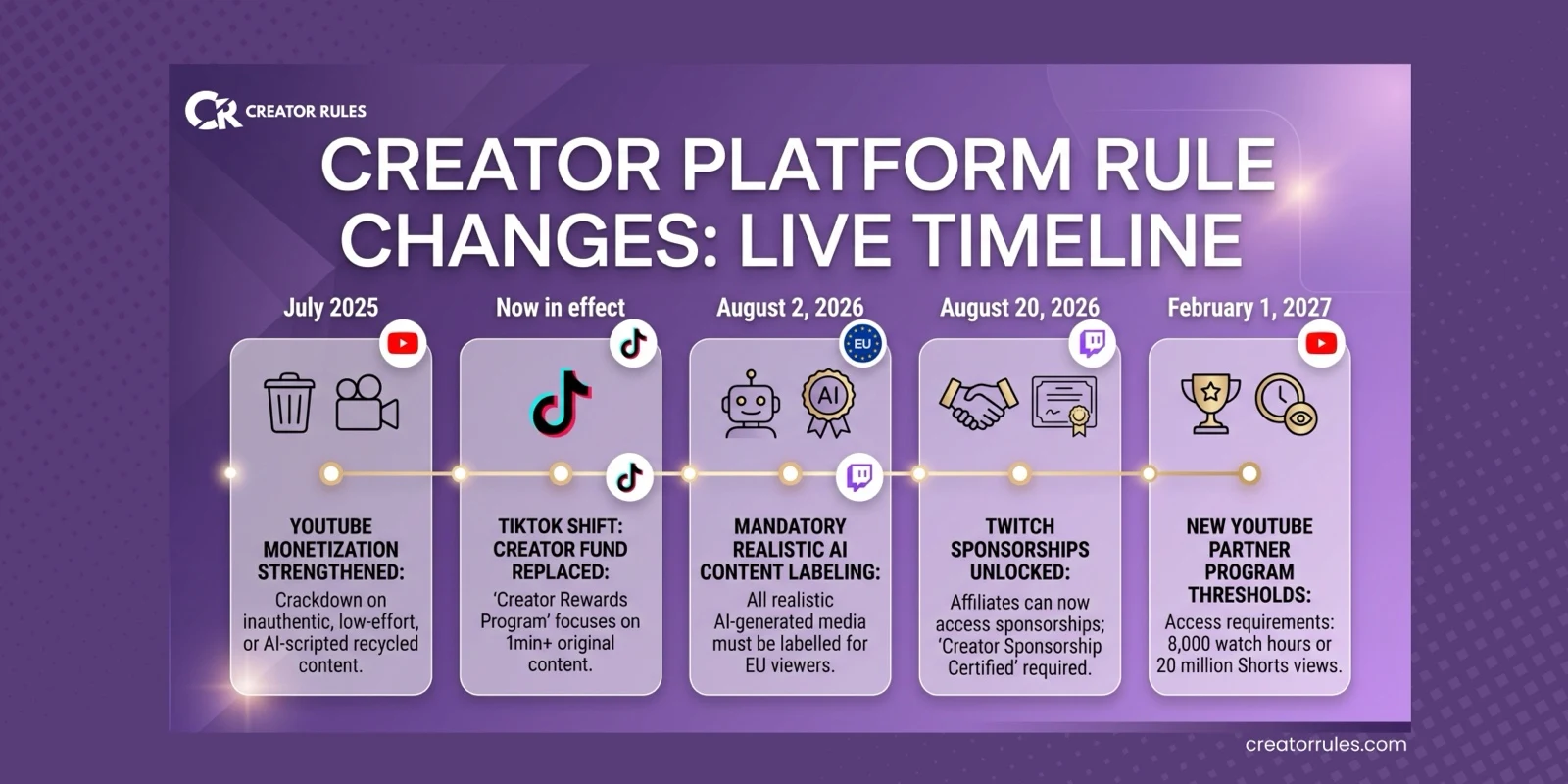
Five things changed for creators between July 2025 and February 2027. Two are already in force, one arrived last month, one is a legal obligation rather than a platform policy, and one is still ahead.
They are usually reported one at a time, which makes each sound bigger than it is. Together they are easier to read: platforms are tightening what counts as original work, and the law is catching up on disclosure.
July 2025: YouTube tightens what counts as original
YouTube updated its monetization policies and renamed one of them. What used to be called “repetitious content” became “inauthentic content”.
The change caused a wave of panic posts claiming YouTube was banning AI. It was not. The policy targets mass-produced and repetitive uploads that add nothing of their own, whether a person or a tool made them.
Who this actually affects: channels built on stock footage with synthetic narration, compilation channels that reupload other people’s clips, and template channels that publish the same video with a different topic swapped in.
What to do: nothing, if your videos carry your own commentary, editing decisions or reporting. Using AI for a script draft, captions or editing is not what the policy is about.
Now in effect: TikTok’s Creator Fund is gone
The Creator Fund was replaced by the Creativity Program and then by the Creator Rewards Program. Plenty of articles still call it the Creator Fund, which is one reason people apply expecting the old rules.
The requirements: 18 or older, or 19 in South Korea. 10,000 followers. 100,000 video views in the last 30 days. A Personal Account, not a Business Account. And the content itself has to be original and over one minute long.
Who this affects: anyone who built a TikTok audience on short clips. The platform that made its name on fifteen second video now pays only for long.
What to do: check your account type first. Switching to a Business Account disqualifies you, and nothing on the switching screen says so. We covered the full requirements and the four conditions that quietly disqualify people in this guide.
2 August 2026: AI labelling became law in the EU
This is the one that is not a platform policy. Article 50 of the EU AI Act became enforceable on 2 August 2026, which turns AI disclosure from something platforms ask for into something the law requires.
Realistic AI-generated or altered media shown to EU viewers has to be clearly labelled, and marked in a machine-readable format. Deepfakes need a distinguishable label of their own.
The part most coverage leaves out is what is exempt. The obligation covers content a viewer could reasonably mistake for real. It does not cover:
- Clearly unrealistic or animated content
- AI used to draft a script
- Automatic captions
- Colour grading and editing assistance
So “every AI-assisted video needs a label” is wrong. A realistic AI-generated person saying something they never said needs a label. An obviously illustrated thumbnail does not.
Who this affects: not only creators in the EU. The obligation follows the audience, so it applies to anyone whose content reaches EU viewers.
And the penalties are real. Breaches of the transparency obligations can reach 15 million euros or 3 percent of worldwide annual turnover, whichever is higher. That is aimed at companies rather than individuals, but it explains why the platforms moved quickly on labelling tools.
What to do: use the disclosure toggle your platform already provides. YouTube has the “altered or synthetic content” box in Studio. TikTok has an AI label and auto-detects Content Credentials. Meta applies an “AI info” tag on Instagram and Facebook.
Labelling obligations are becoming the pattern rather than the exception. On Instagram the same logic already applies to commercial relationships, and it catches more creators than people expect, because the paid partnership label is required even when the only payment was a free product.
20 August 2026: Twitch opened sponsorships to Affiliates
This is the change with the least coverage and the most immediate upside, and it went almost unnoticed.
Brand sponsorships on Twitch were effectively a Partner benefit. As of 20 August 2026, all brands can invite all Affiliates globally to their first sponsorship.
There is a condition. Affiliates have to be Creator Sponsorship Certified. That means accepting the terms in the Sponsorship Portal and completing a course on Creator Camp. Once done, “Certified Creator” appears on your Creator Profile for brands to see, and certified creators get early access to selected sponsorships.
Who this affects: every Affiliate. Twitch Affiliate is the easiest monetization door of the three big platforms to walk through, and it now leads somewhere it did not before.
What to do: complete the certification and fill in your Creator Profile. Twitch states that a completed profile increases the chance of receiving offers, and it is also surfacing sponsorship offers in the dashboard through a partnership with the creator marketing platform Wehype.
If you are not an Affiliate yet, the requirements changed in early 2025 and are lower than most articles still claim: 25 followers, 4 hours streamed on 4 different days in the last 30, and an average of 3 concurrent viewers. Full detail here.
1 February 2027: YouTube’s thresholds double
The only date on this timeline that has not happened yet, and the one worth planning around.
| Now | From 1 Feb 2027 | |
|---|---|---|
| Subscribers | 1,000 | 1,000, unchanged |
| Watch hours, 12 months | 4,000 | 8,000 |
| Shorts views, 90 days | 10 million | 20 million |
The two activity routes are alternatives, not both. You need the subscriber count and one of them.
Who this affects: channels applying after 1 February 2027. YouTube’s own wording on existing partners is direct: “This update won’t impact creators already in YPP.”
What to do: if you are close to the current thresholds, applying before the date is worth more than any other optimisation you could make this year. We worked out what 8,000 hours means in daily terms, and why some channels never reach it, here.
What the five have in common
Read separately they look like five unrelated announcements. Read together there are two directions.
The bar for what counts as your own work is rising. YouTube’s inauthentic content policy, TikTok’s one minute minimum and its exclusion of Duets and Stitches all point the same way. Volume is worth less, original contribution is worth more.
And disclosure is no longer optional. What was a platform preference in 2024 is a legal obligation in the EU as of last month, with penalties attached.
The one piece of good news is the Twitch change, and it is the one almost nobody wrote about. A door that was closed to Affiliates is open, and the only cost of walking through it is a course.
Sources
- YouTube Help, YouTube monetization policies, support.google.com
- YouTube official blog, changes to the Partner Programme, blog.youtube
- TikTok Creator Academy, Creator Rewards Program eligibility, tiktok.com
- Twitch blog, Sponsorships Are Now Available to Affiliates, 20 August 2026, blog.twitch.tv
- Regulation (EU) 2024/1689, the AI Act, Article 50, eur-lex.europa.eu
Rules change and vary by region. Check the platform’s own pages before making decisions about your channel.