Demonetized or Rejected on YouTube: Which Clock Is Running
Two emails from YouTube can ruin the same week, and they do not mean the same thing. One says your application to the YouTube Partner Program was not approved. The other says your channel has been removed from it. Most creators search for the same advice after both, and end up reading deadlines that do not apply to them.
The numbers really are different. So is the first thing you should do.
Here is the short version. If you were rejected, the clock is about getting back in line. If you were removed, the clock is about getting your appeal in on time.
If your application was rejected
This is the more common of the two, and it is the one YouTube documents most clearly. You applied, the review came back negative, and the email tells you which policies your channel did not meet.
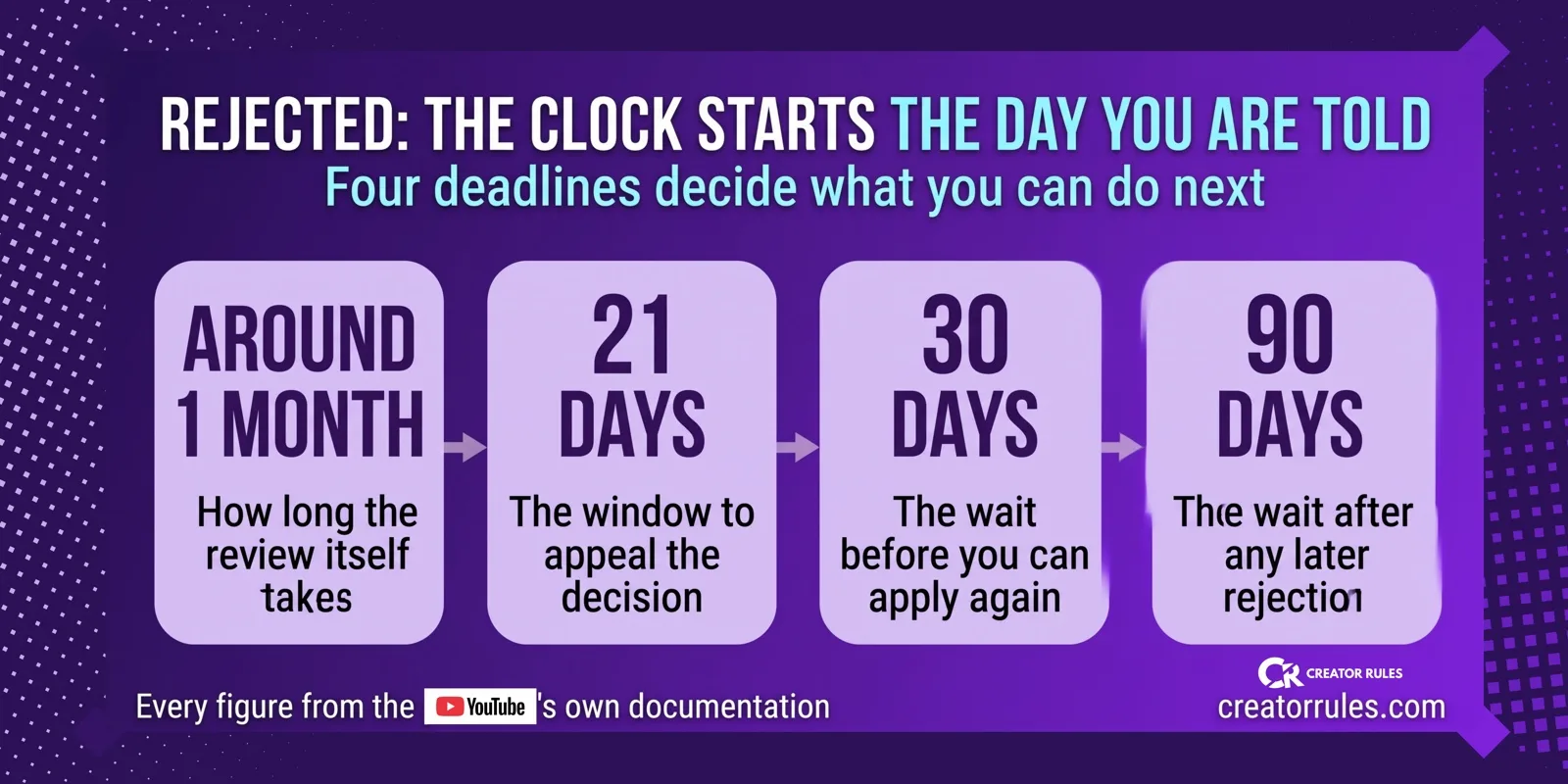
The review itself takes about a month by YouTube’s own estimate. That is the wait between applying and hearing anything at all, and it explains why so many creators assume they have been forgotten.
Once the rejection arrives, two separate clocks start on the same day.
The first is the appeal window: 21 days. That applies no matter how many times you have applied before. The second is the wait before you can simply apply again. After a first rejection that wait is 30 days from the date of the rejection email. After any later rejection it becomes 90 days.
That jump from 30 to 90 is the part worth slowing down for. It means a second rejection costs three times as much time as the first one, which makes reapplying quickly a far more expensive gamble than it looks. If your channel was turned down for something structural rather than something you can fix in a fortnight, the 30 day window is not a deadline you have to hit.
If your channel was removed from the programme
This is the situation people usually mean when they say demonetized: you were in the Partner Program, and now you are not. The process around it is built differently, because here YouTube is taking something away rather than declining to grant it.
Sometimes there is a warning first. If YouTube notifies you that your channel is scheduled for suspension and invites you to submit information before it takes effect, you have 7 days to respond. This window is easy to miss precisely because the suspension has not happened yet and the email does not read like an emergency.
If the suspension has already happened, the appeal window is 21 days from the suspension. YouTube says its teams respond within 14 days with a decision.
Then the two outcomes diverge sharply. If the appeal succeeds, you are re-admitted to the programme within 30 days. If it fails, or if you never appealed, you can apply again 90 days after your suspension date.
The numbers side by side
| What happened | Application rejected | Removed from the programme |
|---|---|---|
| Warning before it happens | None | Sometimes, with 7 days to respond |
| Window to appeal | 21 days | 21 days |
| Time to get a decision | About a month for the original review | 14 days for the appeal |
| What 30 days means | You may apply again, after a first rejection | You are re-admitted, if the appeal succeeded |
| What 90 days means | You may apply again, after any later rejection | You may apply again, from the suspension date |
Read that bottom half twice. Thirty days and ninety days appear in both columns and mean completely different things in each. In a rejection, 30 days is permission to try again. In a suspension, 30 days is how long it takes YouTube to put you back after you have already won. Advice written for one situation and applied to the other will send you to the wrong screen at the wrong time.
The one number that is the same
Twenty one days is the appeal window in both cases, and it is the only figure that carries across. If you take one thing from this page, take that.
It also happens to be the shortest of the deadlines, and the only one where doing nothing is a decision. The 30 and 90 day waits pass whether you act or not. The 21 days do not come back.
What the appeal actually looks at
An appeal reviews your channel in its current state, not in the state it was in when the decision was made. That single fact changes what you should do in the hours after the email arrives.
The instinct is to delete. Pull the videos you think caused it, clean the channel up, then appeal. That instinct works against you here, because the reviewer is looking at what is on the channel now, and a channel stripped of its content is not obviously a better case than the one that was assessed. YouTube’s own guidance is to leave things in place before submitting.
Fix what genuinely breaks policy. Do not perform a clearout in the hope that it reads as contrition.
Why the two get confused
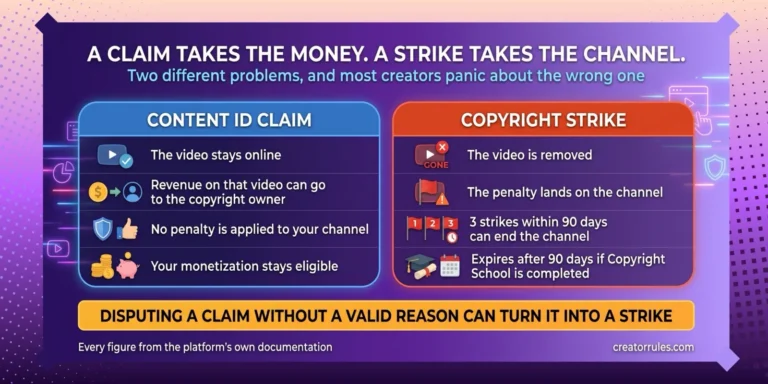
The vocabulary is the problem. Creators say demonetized for every version of losing money, which covers being turned down for the programme, being removed from it, having individual videos limited, and having revenue diverted by a copyright claim on a single upload. Those are four separate systems with four separate remedies.
The email you received will tell you which one you are in, and it is worth reading it for that alone before searching for anything. A rejection names the policies your application did not meet. A suspension refers to your channel being removed from the programme. A claim concerns one video and never mentions the programme at all.
Before you reapply
Whichever clock you are on, reapplying is only worth doing once the reason is actually gone, and that usually means going back to the entry conditions rather than to the rejection email. Those conditions are set out in the Partner Program requirements, and the subscriber and watch hour side of it is where most applications quietly fail rather than on anything dramatic.
It is also worth knowing which behaviours put an existing membership at risk in the first place, since the removal route is the one with the shorter fuse and the smaller window. We covered that separately in what actually costs channels their monetization.
The practical order
Open the email and establish which of the two you are in. If you were removed and there is still a pre suspension window open, that 7 days is the most valuable time you have. If you have already been suspended or rejected, mark the 21st day, because that is the only deadline that closes permanently.
Then decide honestly whether you have a case or a repair job. An appeal is for a decision you believe is wrong. A wait is for a decision that was right and can be fixed. Choosing the appeal when you needed the repair does not just fail, it spends the window you could have used to actually meet the bar.
Every figure on this page comes from YouTube’s own help documentation. The numbers that circulate elsewhere tend to be the ones from the other column.