YouTube Monetization Requirements Explained: Subscribers, Watch Hours and Shorts
Last updated: 26 August 2026. Every figure and rule on this page comes from YouTube’s own help documentation, linked at the bottom.
Most people can recite the YouTube monetization requirements: a thousand subscribers, four thousand watch hours. The numbers are the easy part. What actually delays channels for months is the counting, because a large share of the watch time creators assume they have does not qualify at all.
This page explains how each requirement is measured, which uploads count towards it and which are quietly excluded, and what has to be in place beyond the numbers. If you are looking for the higher thresholds arriving on 1 February 2027 instead, those are set out in our page on the 2027 Partner Program changes.
The two routes into the programme
There is one entry requirement everybody shares, and then a choice of two routes.
| Requirement | Current threshold |
|---|---|
| Subscribers | 1,000 |
| Route 1: long-form | 4,000 qualified watch hours in the last 12 months |
| Route 2: Shorts | 10 million qualified Shorts views in the last 90 days |
You need the subscribers plus one of the two routes. They are alternatives, not a combined total, and you cannot add watch hours and Shorts views together to make up a shortfall on either.
Both windows are rolling. The watch-hour window looks back over the last twelve months and the Shorts window over the last ninety days, so a hour earned thirteen months ago has already dropped out of your total. A channel that stops uploading does not hold its position; it slides backwards as old material ages out of the window.
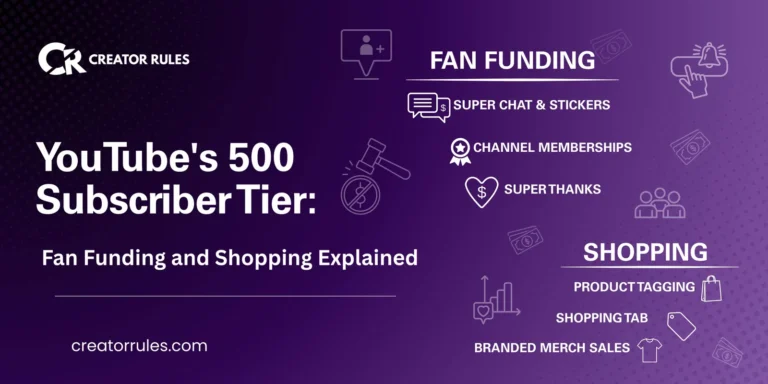
The lower of those two routes has its own rules and its own limits on what it actually unlocks, which we set out in the 500 subscriber tier.
What counts as a watch hour
This is where the surprises are. Only watch time from long-form videos you have set to public counts towards the 4,000 hours.
YouTube explicitly excludes the following:
- Private videos
- Unlisted videos
- Deleted videos
- Ad campaigns, meaning views you paid for
- YouTube Shorts
- Livestreams that are unlisted, deleted, or not converted to VOD
Two of those cause most of the damage.
Shorts do not count towards watch hours. A channel can accumulate millions of Shorts views and still sit at close to zero qualified watch hours, because Shorts feed the separate ten million route and nothing else. Creators who split their output between formats often assume the two totals help each other. They do not.
Deleting a video deletes its watch time. Clearing out old uploads because they feel embarrassing or off-brand removes every qualified hour they earned. If a video is genuinely a problem, setting it to private also removes its hours, so there is no safe way to hide it and keep the credit. The only version that keeps counting is a public one.
Livestreams are worth a separate note. A stream counts while it is public and remains counted if it stays available as video on demand afterwards. If it is left unlisted, deleted, or never converted to VOD, those hours disappear.
How long that threshold takes in practice depends far more on video length and retention than on how often you upload, and we ran the arithmetic in how long the watch hour threshold actually takes.
What counts as a Shorts view
The Shorts route counts qualified views from public Shorts that appear in the Shorts Feed. Excluded are private Shorts, unlisted Shorts, deleted Shorts, views bought through ad campaigns, and image posts that appear in the Shorts Feed.
That last exclusion catches people out. Image posts surface in the same feed and generate what look like views in your analytics, but they are not video and they do not count towards the ten million.
The ninety-day window makes this route sharper than it first appears. Ten million views is not a lifetime total, it is a quarterly rate, which means the Shorts route rewards consistent output rather than one video that happened to travel.
The requirements that are not numbers
Reaching the thresholds does not by itself get you accepted. YouTube also requires all of the following to be in place:
- You follow the YouTube channel monetization policies
- You live in a country or region where the Partner Program is available
- Your channel has no active Community Guidelines strikes
- 2-Step Verification is switched on for your Google Account
- Your channel has advanced features access
- You have one active AdSense for YouTube account
Several of these take time that creators do not budget for. Advanced features access requires its own verification step. An active strike expires on its own schedule, and applying while one is live is a wasted application. The AdSense requirement says one account, which matters for anyone who has previously created several and forgotten about them.
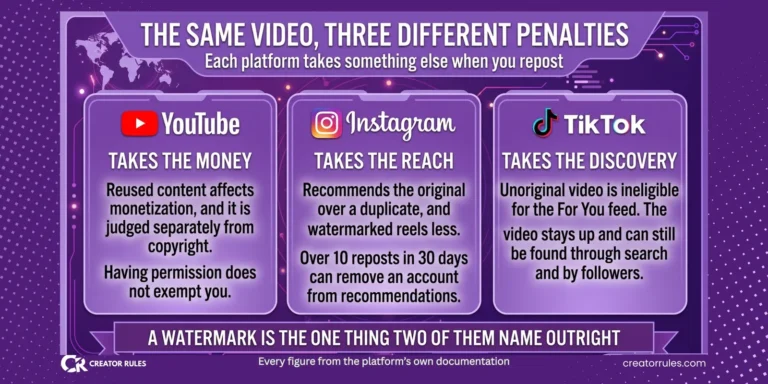
The most common failure in this group is the monetization policies themselves. Reused content, material you did not create or meaningfully transform, and videos that repeat the same template with little variation are all judged here, not against the numbers.
What happens after you apply
Review takes about one month in typical cases, and YouTube says delays beyond that are possible. A human reviews the channel as a whole rather than a single video, which is why a channel that technically qualifies can still be turned down on content grounds.
If you are rejected, you have two options. You can appeal within 21 days, or you can keep uploading and reapply after 30 days. A second rejection lengthens the wait considerably: after that, the reapplication window is 90 days.
That escalation is the argument against applying the moment you cross the line. If there is anything on the channel that might read as reused or templated content, fixing it first costs less than a rejection that puts you on a ninety-day clock.
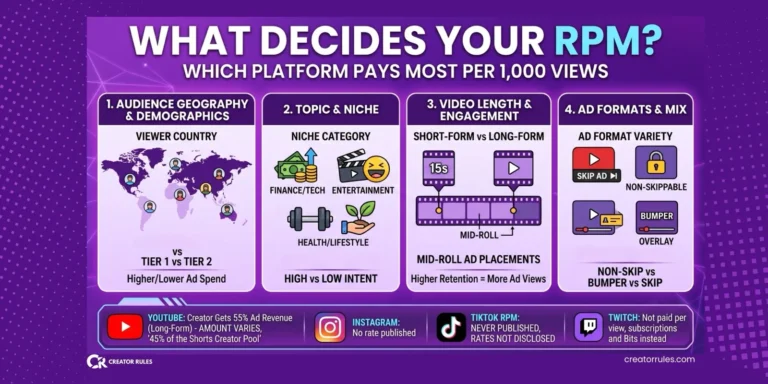
What the programme pays once you are in is a separate question, and the honest answer is that no fixed rate exists: what platforms actually pay per 1,000 views.
The mistakes that cost people months
- Counting Shorts views as progress towards watch hours. They are two separate routes and neither feeds the other.
- Deleting or privatising old videos. Their watch time goes with them, and you can be pushed back below the line by a tidy-up.
- Leaving livestreams unconverted. Hours from a stream that never becomes a public VOD do not survive.
- Applying with an active strike. The application will not succeed and the attempt is spent.
- Forgetting the rolling window. A pause in uploading does not freeze your total, it lets it decay.
- Applying before cleaning up borderline content. A first rejection costs 30 days, a second costs 90.
What changes in 2027
Everything above describes the rules as they stand. From 1 February 2027 the two routes double, to 8,000 qualified watch hours and 20 million qualified Shorts views, and a separate rule governs whether existing channels keep earning from Shorts. The counting rules on this page are not changing, only the totals they are measured against.
The full detail, including what it means for channels already in the programme, is on our page covering the 2027 Partner Program changes.
Sources
- YouTube Partner Program overview & eligibility, YouTube Help
- New opportunities to earn and changes to the YouTube Partner Program, YouTube Official Blog, 10 August 2026
Creator Rules is an independent publication and is not affiliated with YouTube or Google. This page is general information, not financial or legal advice, and it does not replace YouTube’s own terms.