Instagram Paid Partnership Label: The Rules for Branded Content
Most creators treat the paid partnership label as a formality, a box to tick once the deal is signed. It is not. On Instagram the label is the mechanism itself, and there are three gates in front of it that catch people out long before their first sponsored post goes live.
The first gate stops a large number of creators before they start, and almost nobody sees it coming.
What Instagram counts as branded content
Start with the definition, because it is wider than most people assume. Instagram describes branded content as a creator or publisher’s content that features or is influenced by a business partner for an exchange of value.
Read that last part again. An exchange of value is not the same as a payment. A gifted product is an exchange of value. A free hotel stay is an exchange of value. A discount code arrangement, a loaned camera, a ticket to an event: all of it counts.
This is where the most common failure happens. A creator who would never dream of skipping disclosure on a paid campaign posts an unlabelled video about a product a brand sent for free, because in their mind nobody paid them. Instagram’s definition does not distinguish between the two.
The first gate: a personal account cannot do this at all
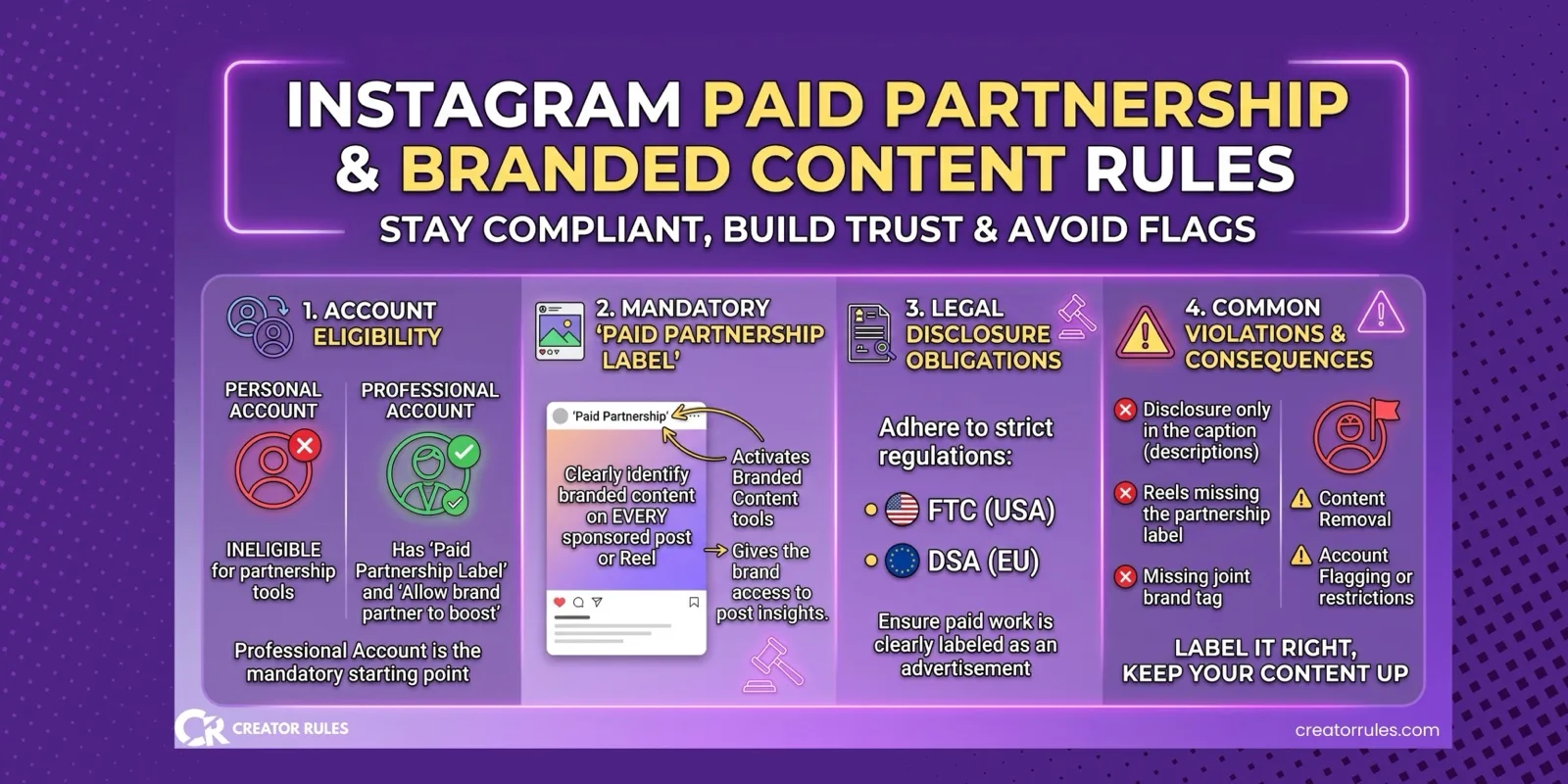
The paid partnership label and the setting that lets a brand boost your post are not available on a personal account. They live in the professional account tools, and Instagram states plainly that creators and publishers must be on a professional account to post branded content or run partnership ads.
There is no workaround and no partial version. If your account is personal, the label simply does not exist in your posting flow. Switching is free and takes under a minute, but it has to happen before the campaign, not after the post is live.
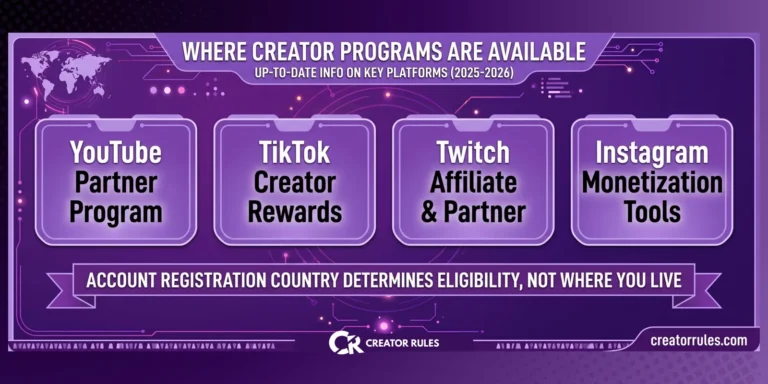
And here is a trap worth knowing if you work across platforms, because the two biggest ones point in opposite directions. On TikTok, switching to a Business Account disqualifies you from the Creator Rewards Program, which pays on views. On Instagram, staying on a personal account disqualifies you from branded content tools. A creator posting to both has to get the account type right on each, and the correct answer is different on each.
What the label actually does
The label looks like a line of text above your post. It is doing three separate jobs.
It discloses. The viewer sees that the post is a commercial arrangement before they read a word of your caption. That is the part everyone knows about.
It activates the branded content tools. Tagging the business partner is what turns an ordinary post into a branded content post in Instagram’s system. Without the tag, as far as the platform is concerned, you posted an ordinary video that happens to mention a brand.
It gives the brand access to the post’s insights. This is the part creators underestimate, and it is usually what the brand actually wants. Once tagged, the business partner can see how the post performed. Many contracts assume this access exists. If you never applied the label, you cannot produce those numbers later, and that is an awkward conversation to have after the campaign.
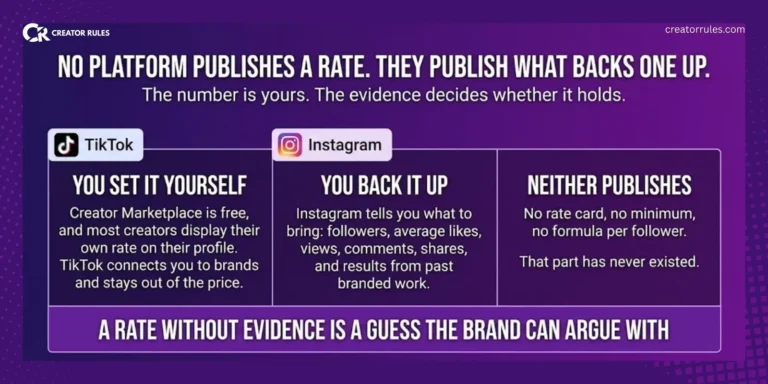
Instagram publishes no follower number, again
Instagram says creators must have an authentic, established presence, which includes maintaining a sufficient follower base. It does not say what sufficient means.
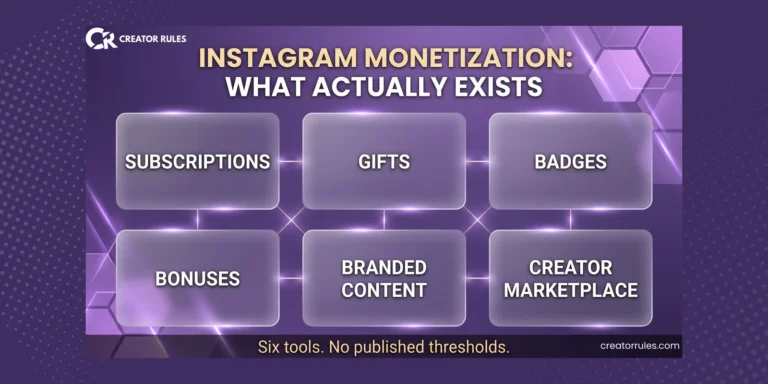
If that sounds familiar, it should. We found exactly the same pattern when we looked at how Instagram monetization works: six tools listed, not a single threshold attached to any of them. Instagram consistently describes what you need to be rather than what you need to reach.
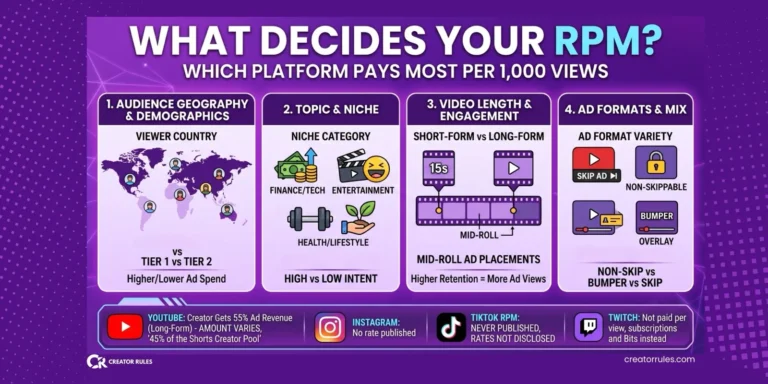
So treat any article that gives you a follower requirement for branded content the same way you should treat a confident RPM figure. Someone worked it out from their own experience, and that is not the same as a published rule.
Instagram’s rules and the law are two separate things
This is the distinction that causes real trouble, because satisfying one does not automatically satisfy the other.
Instagram’s branded content policies are platform rules. Enforcement comes from Instagram, and the consequences are Instagram’s to hand out. Sitting alongside them are actual legal obligations: the FTC’s disclosure rules in the United States, and the DSA’s advertising transparency requirements in the European Union.
Those legal obligations follow your audience, not your own location. A creator outside the EU with meaningful EU reach is inside the DSA’s scope, in the same way that the EU AI Act’s labelling duty follows the viewer rather than the publisher.
The practical takeaway is simple. Use the label because Instagram requires it, and make the commercial nature obvious in the content itself because the law requires that. The label is a strong step towards compliance. It is not a legal safe harbour on its own.
The four mistakes that get content removed
Disclosing only in the caption. Writing “thanks to our partner” at the end of a caption is not the paid partnership label. The label is a structural tag on the post, not text you type. A caption disclosure without the tag leaves the post untagged in Instagram’s system, and it also buries the disclosure below the fold where most viewers never look.
Labelling feed posts but not Reels. This is the single most common gap. Creators apply the label carefully to a grid post and then publish the Reel version of the same campaign without it, usually because the Reels flow feels different. Both need it.
Missing the brand tag. The label is only complete when the business partner is actually tagged. A label with no partner attached does not activate the tools and does not give the brand its access.
Assuming gifted products do not count. Back to the definition. An exchange of value includes things that arrive for free.
What actually happens when you get it wrong
Instagram’s response is not dramatic, which is precisely why people ignore the rules until it bites.
Undisclosed branded content can be removed. Repeated problems can get an account flagged, and a flagged account can face restrictions on the branded content tools themselves. Separately, Instagram states that content flagged as misinformation can make a creator ineligible to run branded content or partnership ads at all.
Notice what is not on that list. Instagram does not say your account will be deleted for a missing label. The realistic risk is losing the specific thing you were trying to use: the ability to take brand deals on the platform. For someone whose income depends on those deals, that is quite bad enough.
A short check before you post
Four questions, and they take longer to read than to answer.
Did anything of value change hands, including free product? Is this account professional rather than personal? Is the partner tagged, not just mentioned in the caption? Does every format in this campaign carry the label, Reels included?
If all four are yes, you have met Instagram’s requirement. Then ask the fifth: would a viewer who saw only the first three seconds understand that this is an ad? That one is for the law, and it is the question the label alone does not answer.
What to take from this
The paid partnership label is not paperwork attached to a deal. It is the gate the deal passes through.
A personal account cannot use it. A caption line does not replace it. A Reel needs it as much as a feed post does. And a free product triggers it just as a bank transfer does. Get those four right and Instagram’s side is handled, which leaves you free to worry about the part the platform cannot do for you, which is making the commercial relationship obvious to the person watching.
Sources
- Instagram Help Center, Eligibility requirements for partnership ads and branded content
- Instagram Help Center, Branded Content Policies
- Instagram Help Center, What is considered branded content
- Instagram Help Center, About labels on paid partnership posts