Do I Have to Label AI Content on YouTube?
The question almost everyone asks is “did I use AI?”. That is the wrong question, and it is why so many creators either over-label their videos or miss the one case that actually matters.
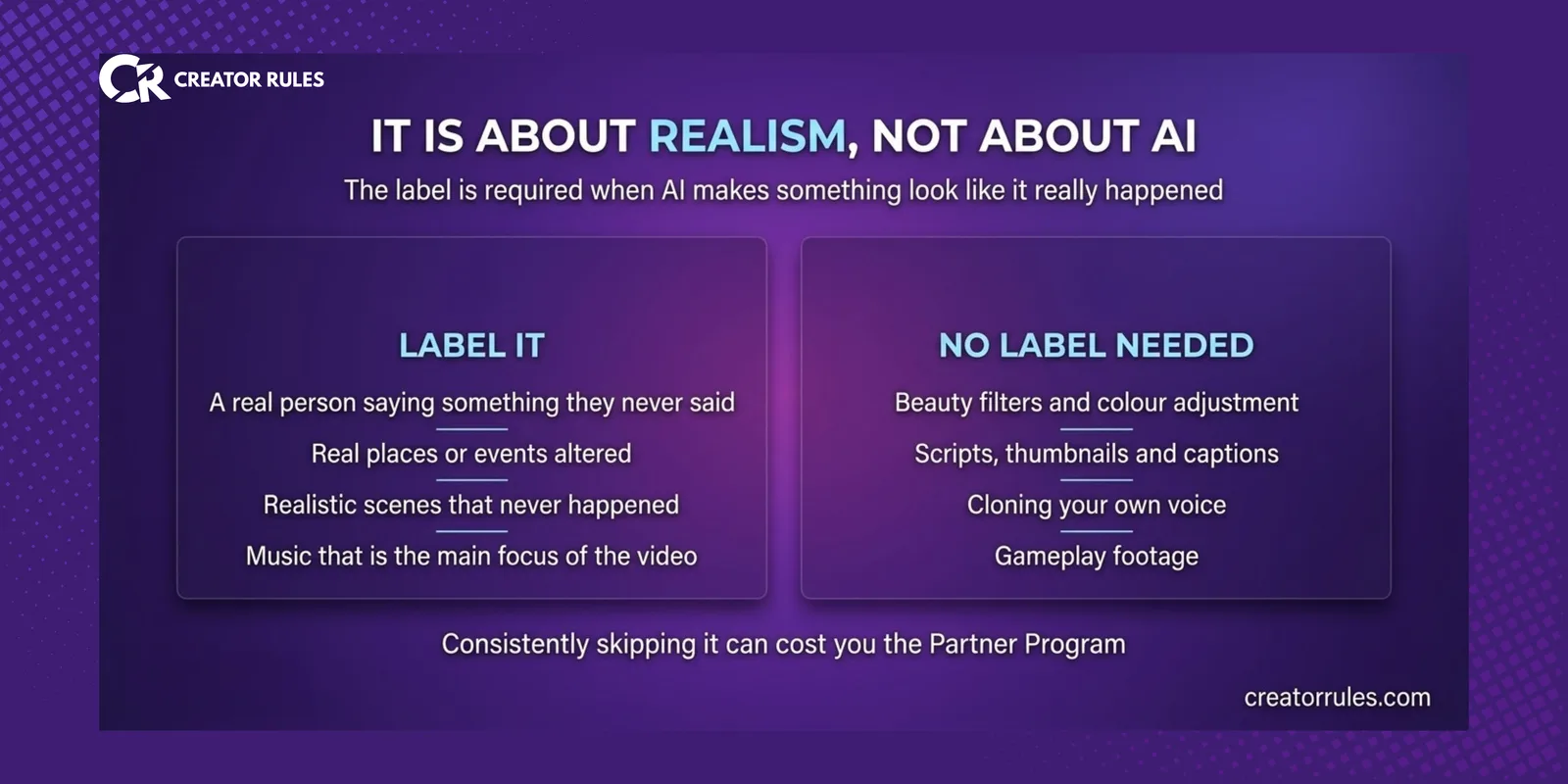
YouTube’s rule is not triggered by using AI. It is triggered by realism: by content that could make a viewer believe something happened when it did not. Once you read it that way, most of the AI in a normal workflow drops out of scope, and the part that stays becomes very easy to recognise.
What actually requires a label
Four situations, and they share one quality. Each of them produces something that looks real and is not.
A real person appearing to say or do something they did not. This is the headline case: synthetic speech in someone’s voice, a face placed into footage, a performance that never took place.
Altered footage of real events or real places. Changing what a real location looks like, or what happened at a real event, so the result still reads as documentary.
Realistic scenes that never occurred. Generated footage of something that could plausibly have happened and did not.
Music that is the main focus of the video. If the AI generated track is the point of the video rather than background, it is disclosed.
Notice what unites them. In every case a viewer could reasonably take the content as a record of reality. That is the entire test.
What does not require a label, and this is the surprising part
YouTube lists these explicitly, and the list is longer than most creators assume.
Beauty filters, colour adjustment and special effects. Standard post production, whether or not an AI model does the work.
Production assistance. Scripts written or improved with AI, AI generated thumbnails, AI written titles and descriptions. None of it is disclosed, because none of it is the video pretending to be real footage.
Caption creation. Automatic subtitles and translations.
Cloning your own voice. This one catches people out in both directions. Using a synthetic version of your own voice is production assistance. Using a synthetic version of somebody else’s is the first case in the previous section.
Gameplay footage. Clearly unreal content in general: animation, fantasy settings, obviously impossible scenes.
So a creator who writes with AI, generates a thumbnail with AI, runs automatic captions and narrates in a cloned version of their own voice has produced a video that needs no disclosure at all. The label is not a confession of AI use. It is a note to the viewer that what they are looking at is not a record of something real.
YouTube can apply the label without you
This is the part that changes the risk calculation, and it is easy to miss.
Disclosure is not only something you tick at upload. YouTube applies the label itself in three situations: content made with its own generative tools, content carrying C2PA provenance metadata, and content its systems detect as AI generated. When that happens you get a notification in Studio.
Which means the practical question is not whether you can avoid a label. It is whether the label on your video was put there by you or found by the system, and the second route is the one that creates a pattern.
The penalty is a monetization risk, and one word carries it
YouTube’s wording on consequences is short: creators who consistently choose not to disclose may face a manually applied label, or penalties including removal of content or suspension from the YouTube Partner Program.
Read “consistently” carefully, because it is doing real work in that sentence. A single missed disclosure is not described as a program level risk. A pattern is. That is the difference between an oversight and a practice, and it is the same logic YouTube applies elsewhere in its policies.
It is also worth separating this from the things it gets confused with. A disclosure label is not an ad restriction: a labelled video keeps earning normally, which is a different mechanism from the yellow icon and limited ads. This is not a copyright question, which runs on an entirely different system we covered in copyright claims versus strikes. And it is not the same as the reused content rule, which asks what you added rather than how real it looks, and which we went through in posting the same video on three platforms.
Music has its own, stricter track
Alongside the creator rule, YouTube runs a separate disclosure for music partners delivering content through distribution channels. There the choice is explicit: content is designated Fully Gen AI, Partly Gen AI or No Gen AI.
The interpretation guidance is unusually concrete. Pitch correction software and AI mastering tools count as No Gen AI. Generating structural layers such as a bassline with AI and recording live vocals over them is Partly Gen AI. And if no information is supplied at all, YouTube says it will rely on its own signals and may designate the content as fully or partly Gen AI by itself.
That last sentence is the one to take away. Supplying nothing is not a neutral choice; it hands the decision to a system that has no reason to guess in your favour.
What this means in practice
Three things, and the first is the one that saves the most time.
Stop labelling production work. If AI helped you write, design, caption or edit, there is nothing to declare. Over-labelling costs you nothing with YouTube, but it does tell viewers your video contains synthetic footage when it does not, and that is a reach problem rather than a policy one.
Label realism every time, without weighing it up. The moment a real person, a real place or a real event is involved and the result looks genuine, disclose it. The cost of disclosing is a line of text. The cost of a pattern of not disclosing is in the same sentence as the Partner Program.
Check Studio notifications. If YouTube has labelled something for you, you want to know, because that is the signal that its systems are reading your uploads differently than you are. If the label is wrong you can address it; if it is right, it is information about what you are actually publishing.
None of this is a reason to avoid AI tools, and YouTube is building plenty of its own, which we listed in the rundown of what is coming in 2027. The rule is narrower than its reputation. It asks one question, about realism, and most of what creators do with AI never reaches it.