How Will Custom Feeds Change Who Finds My Videos?
Most of the 2027 announcements are tools you will use. This one is a change to the room you work in.
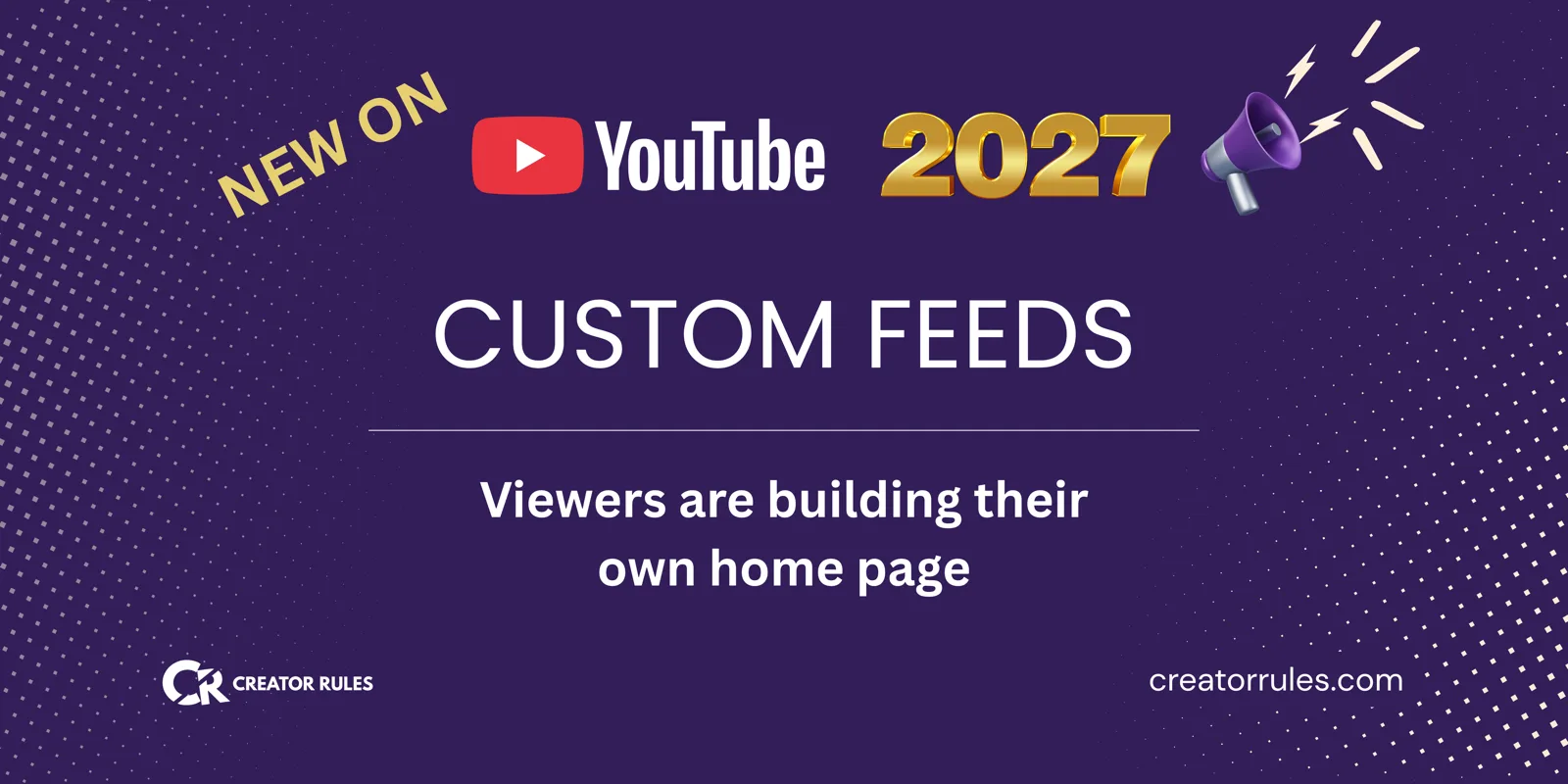
YouTube is letting viewers build their own home page feeds by describing what they want in plain language, and save several of them. The example YouTube gave is specific enough to be worth reading twice: “Witty podcasts for my daily 30-minute commute.”
Creators have barely discussed this, and it may be the announcement that changes distribution most.
What was announced
Custom feeds let a viewer design their own homepage feeds using conversational prompts, save multiple feeds to their home screen, and have them update automatically. It is listed as coming soon with no date.
Alongside it, Ask YouTube is expanding into product recommendations, and music and podcast discovery are getting their own conversational entry points. The direction is consistent: the viewer describes what they want instead of accepting what they are offered.
A described feed is a different thing from a watched feed
This is the part worth sitting with.
Today’s home page is built from behaviour. What you watched, how long you stayed, what you clicked next. It is a model of you assembled without you being asked, and it is very good at finding the thing you did not know you wanted.
A described feed is built from intent. The viewer says what they want, in words, on purpose. That is a narrower input and a more honest one, and it will behave differently in at least two ways.
It is less likely to surprise. A feed defined as “witty podcasts for my commute” is a filter, and a filter excludes. The documentary channel that would have reached that viewer through a sideways recommendation does not match the description.
It is more durable. Behavioural feeds drift. One week of watching something out of character and the home page follows. A described feed stays what it was described as, which is exactly why viewers will like it: several creators at the event said they keep separate accounts to protect their recommendations from other people in the house.
What this means for how people find you
Two implications, pointing in opposite directions.
If you are findable by description, this helps you. A channel that is clearly one thing, that a viewer could name in a sentence, matches the kind of prompt people will write. “Long documentaries about abandoned places” is a describable thing. A channel that is that thing benefits from viewers who ask for it by name.
If you depend on the sideways recommendation, this is a risk. Plenty of channels grow because the algorithm puts them in front of someone who was not looking for them. A described feed has fewer of those slots, because the viewer has drawn a boundary and the system is respecting it.
The unknown, and it is a large one: how much of the home page these feeds actually replace. If they sit alongside the normal feed as an extra tab, the effect is small. If viewers live in them, the effect is not. YouTube has not said, and the answer will probably differ by viewer anyway.
The practical response is clearer positioning
There is a response here and it is not a trick.
If viewers are going to describe what they want, the useful question is whether your channel is describable. Not your niche, your channel. Could a viewer who likes you write a sentence that would pull you in?
For most channels the honest answer is that the sentence exists but the channel does not state it anywhere. The title says one thing, the about page says another, the last five uploads suggest a third.
Three things worth tightening, all of them free:
The channel description. Written once, usually years ago, usually vague. If a system is matching descriptions to descriptions, this is no longer decoration.
Playlists and series. A channel organised into named things is easier to match than an undifferentiated upload history. Shorts seasons and episodes appeared in the same announcement, which suggests the platform is pushing structure in several places at once.
Consistency in what you actually publish. The hardest one, and the only one that really matters. A channel that is three channels is hard to describe, and a described feed is where that finally costs something.
What has not been said
Whether creators get any visibility into this at all. There is no announced metric for how often a channel appears in custom feeds, no way to see which descriptions pull you in, and nothing suggesting analytics will report it separately from the normal home page.
Which means that if this changes where your views come from, the first sign will be a shift in traffic sources with no explanation attached to it.
The rest of the 2027 list, separated into what is confirmed and what still has no date, is in every YouTube feature announced for 2027.