Will YouTube Tell Me If My Video Is Weak Before I Publish?
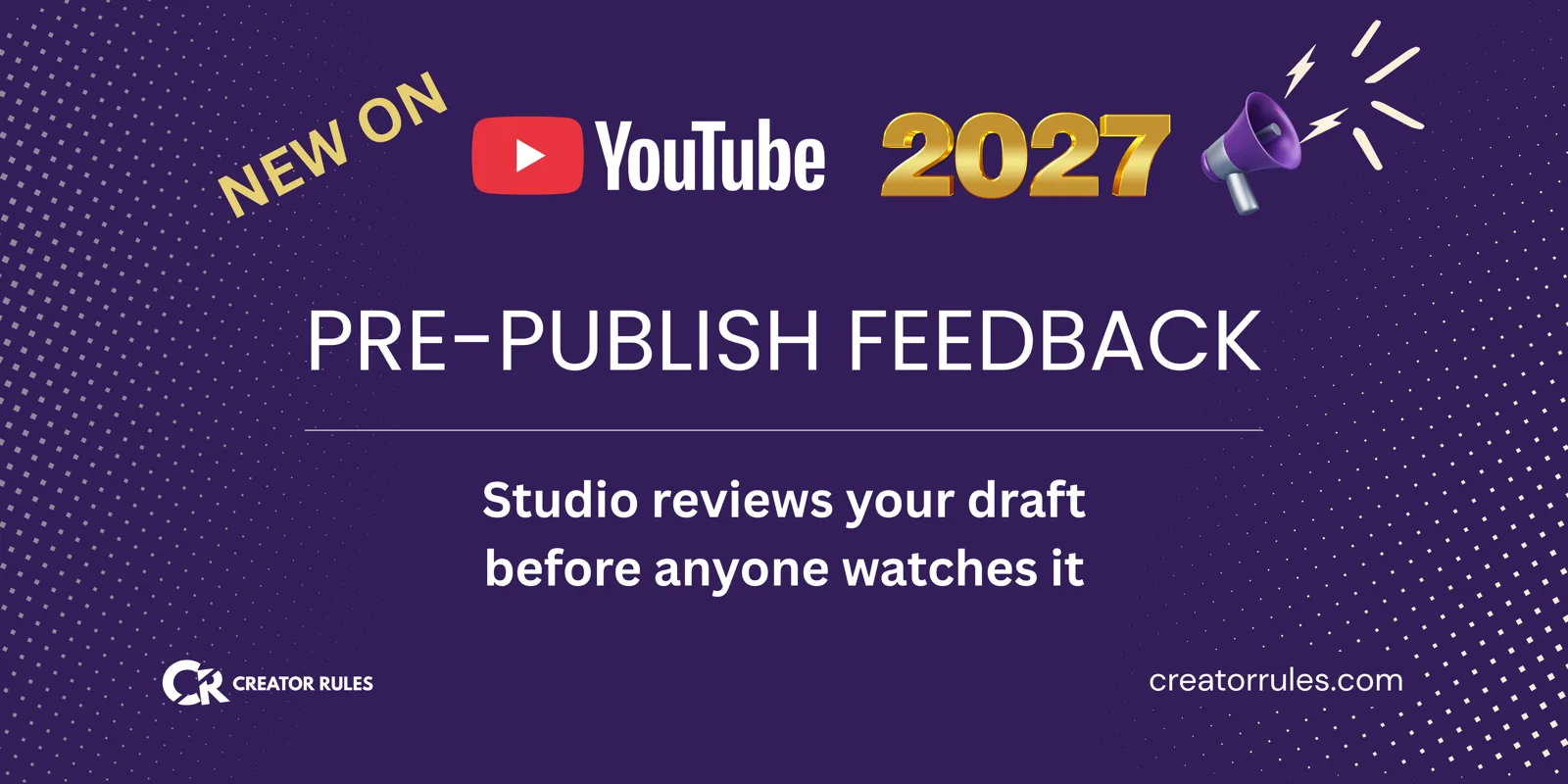
YouTube Studio is getting a feature that tells you what is wrong with a video before anyone has watched it. Personalised advice on pacing, structure and storytelling, delivered while the video is still a draft.
It is the announcement creators reacted to most warmly at the event, and the one with the largest gap between what was described and what was shown.
What was announced
YouTube said Studio is becoming an end to end creative partner, and that creators will be able to get personalised guidance on early drafts. The stated areas are pacing, structure and storytelling. Alongside it sit channel-matched thumbnail generation and an expanded research area for finding outlier videos.
No demo was shown. Creators who attended described it as a feature that was announced rather than displayed, and the specifics of what the advice looks like were not covered.
The question that decides whether this is useful
⚠️ What is the advice based on?
There are two plausible answers and they produce very different tools.
If it is based on your channel’s own data, this is potentially excellent. YouTube knows exactly where viewers left your last forty videos. Advice built on that is advice nobody else can give you, including you, because you cannot see the pattern across forty retention graphs as clearly as a system can.
If it is based on general principles, it is a writing assistant with a YouTube logo. “Your opening is slow” is a sentence anyone can produce without watching anything, and creators have had access to that quality of feedback for years without it changing their work.
The announcement does not say. Until it does, treat enthusiasm about this feature as premature, including your own.
Where feedback before publishing genuinely helps
Assume the good version for a moment, because there is a real problem it would solve.
The current loop for improving a video is brutal: publish, wait, read the retention graph, apply the lesson to the next video. That lesson arrives after the video it was about is finished. You cannot fix the thing you learned about, only the next one.
That loop is also slow in a specific way. A creator publishing weekly gets fifty data points a year, and each one teaches about a video that is already out.
Feedback on a draft breaks that. Not because the advice is better, but because it arrives at the only moment when acting on it is free.
Where it will not help, and a risk worth naming
Two limits.
It cannot tell you whether the idea is good. Pacing, structure and storytelling are execution. The most common reason a video underperforms is that nobody wanted it, and no draft review catches that.
And there is a sameness risk. If a large number of channels take structural advice from the same system, the advice converges. The result is videos that are all competently paced in the same way. Anyone who has watched the thumbnail style of an entire niche shift in one direction knows how fast this happens.
The useful posture is probably the one experienced creators already take with analytics: read it, understand what it is telling you, and keep the right to ignore it when the thing you are making needs to be strange.
How to use it when it arrives
One rule that will probably hold regardless of which version ships.
Use it to find problems, not to choose solutions. If it tells you the middle sags, that is information worth having and it is probably right, because sagging is measurable. If it tells you how to fix the sag, that is a judgement call about your video and your audience, and you have more context than it does.
The creators who get the most out of this will be the ones who treat it as a second pair of eyes rather than an editor. The ones who get least will be the ones who publish whatever it approves of.
Timing, as with most of this list, is unannounced. What is confirmed and what is not is laid out in every YouTube feature announced for 2027.