Why Is My Payout Smaller Than My Earnings?
Your dashboard says one number. Your bank says a smaller one. The difference is rarely a mistake, and it is almost never a single deduction.
It is a stack. Tax withholding, currency conversion and the cost of the payout method itself, each applied separately, each with its own rule. The useful part is that most of them are settings rather than facts of life, and two of them can be taken to zero by changing something in an account page.
First, the part that is not in this gap at all
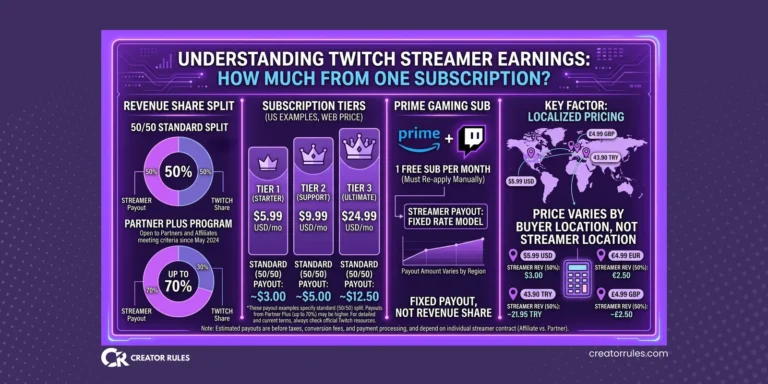
The platform’s own share is not a payout deduction. YouTube’s 55% of watch page ad revenue, Twitch’s 50/50 on subscriptions, Kick’s processing fee: all of that is applied before the number appears in your dashboard. What you see in the earnings screen is already your side of the split.
This matters because the two get mixed together constantly. If you want to understand the split itself, that is a separate question, and for Kick it is a narrower one than the headline number suggests. Everything below happens after the split, to money that is already yours.
US tax withholding is the biggest single cut
This is the one that costs the most and the one most often left unfixed, because it looks like paperwork rather than money.
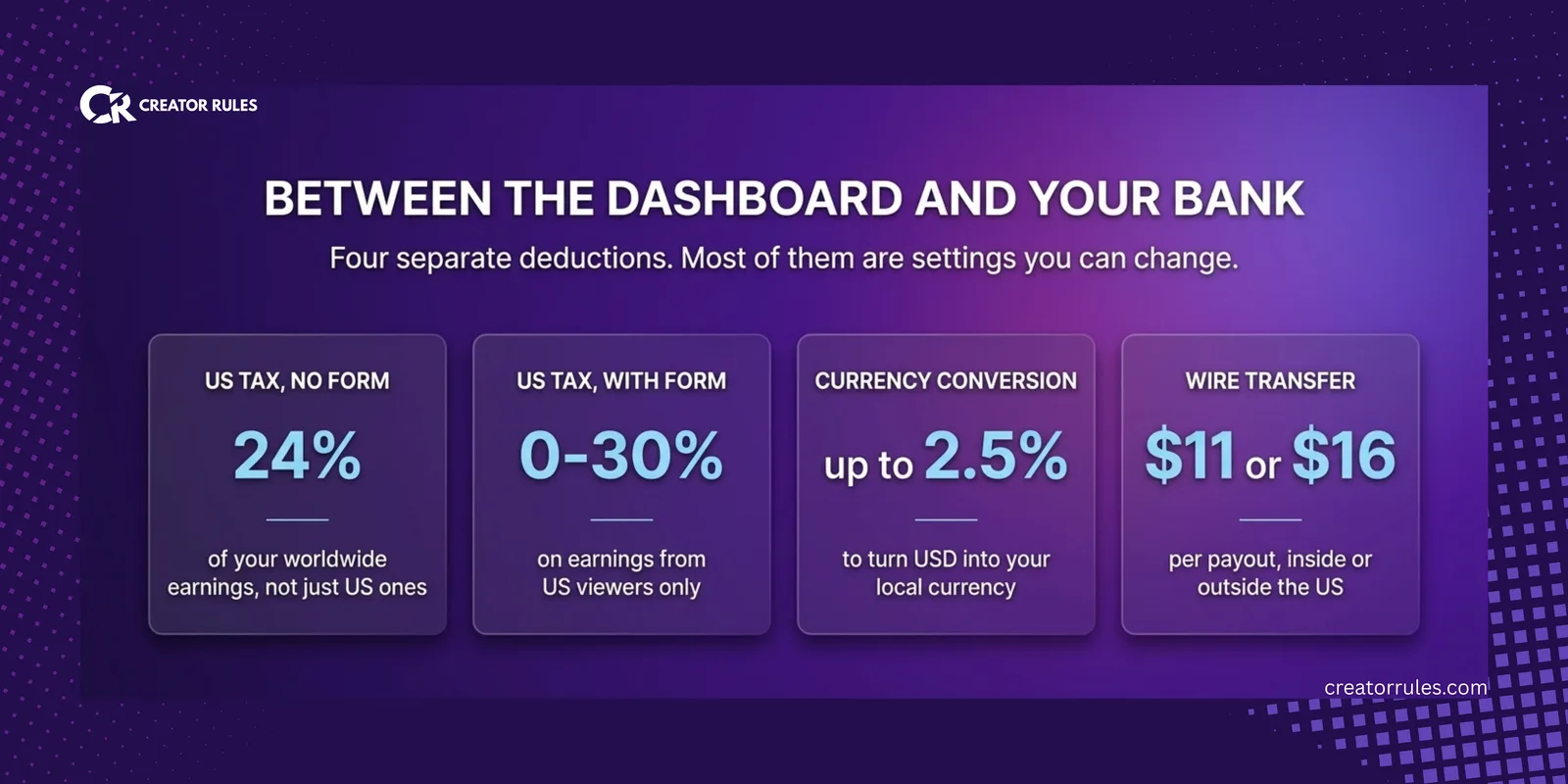
Google’s rule has two halves. If you submit US tax info, withholding is between 0% and 30%, and it applies only to the portion of your earnings that came from viewers in the United States. Where you land in that range depends on whether your country has a tax treaty with the US.
If you do not submit it, the arithmetic changes shape entirely. For an individual account, Google may be required to apply backup withholding of 24% of your total earnings worldwide. Not 24% of your US earnings. All of them.
Read those two sentences next to each other and the asymmetry is hard to miss. A creator in Germany with almost no US audience owes close to nothing under the first rule, and loses a quarter of everything under the second. The form is not a formality, it is the difference between the two. We have gone through the mechanics of it in more detail in our guide to US tax withholding for creators.
One nuance the comparison tables skip: the 24% figure is the individual-account case. A business account outside the US that submits nothing faces 30% of US earnings instead. Different rate, different base, same lesson.
Currency conversion, and who is actually charging it
Most platforms calculate in US dollars and pay you in something else. The conversion has a cost, and the cost does not always come from the platform.
Twitch charges it directly. Converting a payout from USD into a local currency carries a currency exchange fee of up to 2.5% of the transaction, for Affiliates and Partners alike. There is a documented way around it: creators in eligible European countries who take payment in EUR by local bank transfer or SEPA avoid the exchange fee entirely. That is a setting, not a negotiation.
Google does not charge it, your bank does. AdSense does not take a fee for sending a wire transfer. But if your bank account is held in a different currency from your payment currency, your bank applies its own conversion rate, and Google is explicit that the bank may even reject the payment outright. The rate in that case is set by your bank, not by Google, which is why two creators paid on the same day can receive different amounts.
TikTok publishes the principle but not the number. Rewards are calculated in USD, the figure shown in local currency is an estimate, and conversion costs can apply. No percentage is given, so there is nothing reliable to quote.
The payout method has its own price
This is the smallest of the three and the easiest to fix, because it is a dropdown.
Twitch deducts a wire transfer fee of $11 for creators based in the US and $16 for creators outside it, per payout. A rejected wire costs a further $25. ACH, eCheck, PayPal and cheque carry no such fee, which is also why Twitch sets the payout minimum at $50 for those methods and keeps it at $100 for wire, in its own words because of the fees deducted.
On a $60 payout, taking it by wire as a creator outside the US is a 27% haircut on a method you could have changed in thirty seconds. On a $3,000 payout it is a rounding error. The fee is flat, so it punishes small payouts hardest, which is exactly the group least likely to have checked.
What is not a deduction
Payment thresholds are not money lost. If you do not reach $100 at AdSense, $50 at Twitch or $10 at TikTok, nothing is taken from you; the balance rolls into the next month. It feels like a loss because the payout does not arrive, but the number in the account is unchanged. That is a timing question, and we covered the schedules in when creator platforms actually pay.
Account holds are also not deductions, though they stop money just as effectively: an unverified address, missing payment details or incomplete tax information will halt a payout that has cleared every threshold, usually without an obvious alert.
Where the money goes
| Deduction | Rate | Applies to | Avoidable? |
|---|---|---|---|
| US withholding, tax info submitted | 0% to 30% | US-viewer earnings only | Lowered by treaty |
| US withholding, nothing submitted | 24% (individual) | Worldwide earnings | Yes, submit the form |
| Currency exchange, Twitch | up to 2.5% | USD converted to local | Yes, EUR via SEPA |
| Wire transfer, Twitch | $11 or $16 flat | Each wire payout | Yes, use ACH or PayPal |
| Bank conversion, AdSense | Bank’s own rate | Mismatched account currency | Match the currency |
What to check, in order
Start with the tax form, because it is worth more than the other two combined and it is the only one with a retroactive cost. Open the payments section, confirm tax info is on file, and confirm the treaty claim went through rather than just the submission.
Then look at the payout method. If it says wire and the amounts are modest, change it. Then look at the payment currency against the currency of the receiving account, and make them match if the platform lets you choose.
Finally, work out your own gap once, properly. Take a single payout, not an average: the gross figure for that period, the amount that landed, and the statement that came with it. Three numbers, one subtraction. If the difference is bigger than the rates above can explain, it is worth asking support about rather than guessing at, because at that point something specific to your account is doing it.
None of this makes anyone rich. But a creator paying 24% withholding that should have been 0%, converting currency at 2.5% that could have been free and taking $16 wires that could have been free ACH is losing a meaningful share of a small income to three dropdowns.