Do I Get Paid for YouTube Premium Views?
A Premium member watches your video. No advert plays, because that is the whole point of paying for Premium. So does that view earn you anything, or did someone just watch for free?
It earns you something. But the money takes a completely different route to reach you, and understanding that route explains a few things that otherwise look like errors in your analytics.
The money comes from a subscription, not an advertiser
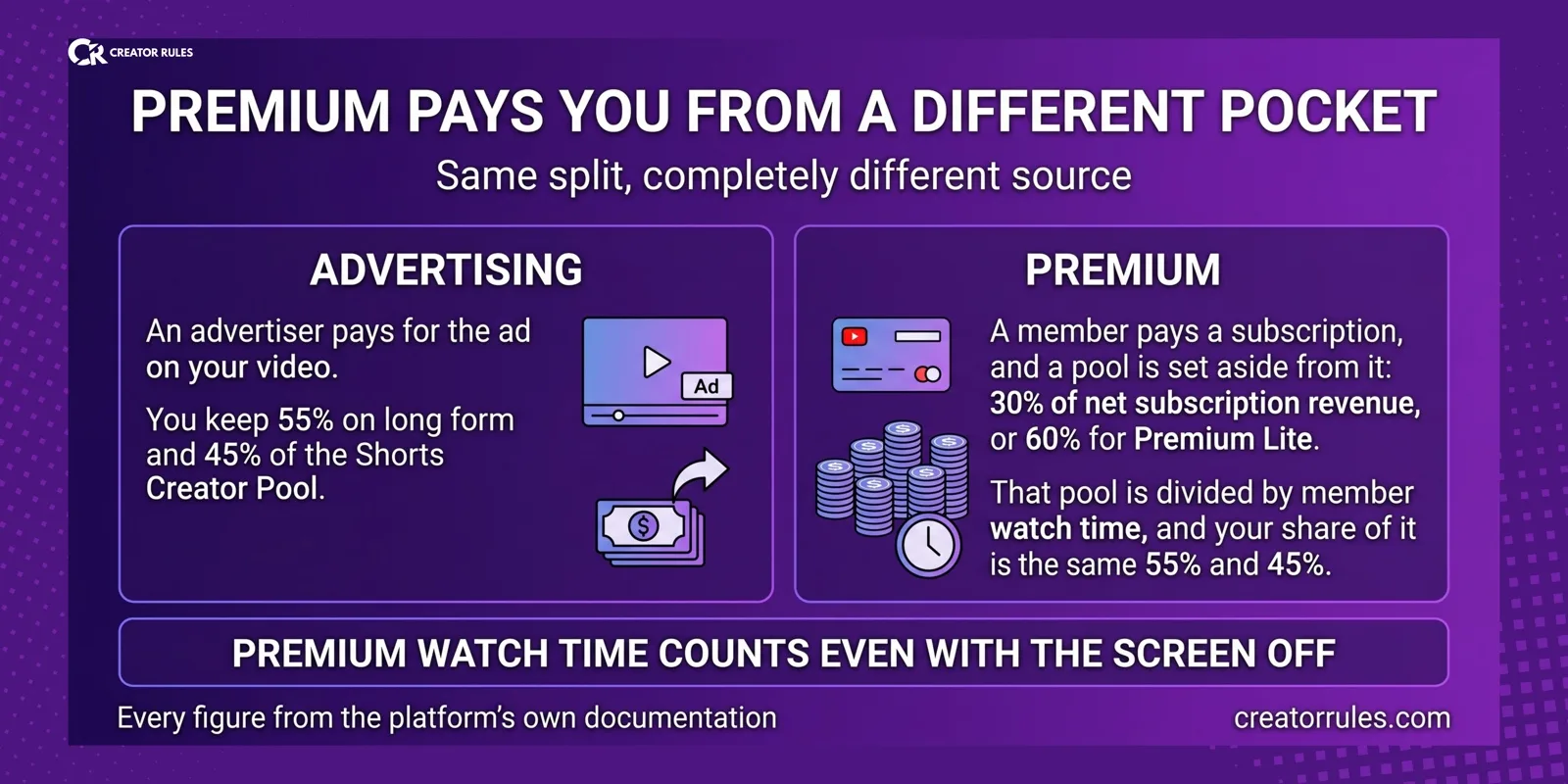
With advertising the chain is short. An advertiser pays to show an ad on your video, and you keep 55% of that on long form or 45% of the Shorts Creator Pool.
Premium has no advertiser in it at all. The member pays a monthly subscription to YouTube, and that money has to be divided among every creator whose content Premium members watched that month. So instead of a payment attached to your specific video, there is a pool, and your earnings depend on your share of it.
First a pool is set aside
Not all of the subscription money goes to creators. YouTube sets aside a portion of the net subscription revenue as the pool: 30% for Premium, and 60% for Premium Lite.
The difference between those two figures surprises people, and there is a reason for it. The share accounts for the costs of running and promoting the service, including what is paid to music partners. Premium includes YouTube Music, so a portion of that subscription is already committed elsewhere before creators are reached. Premium Lite does not carry the same music obligations, which is why a larger share of it flows into the creator pool.
Then the pool is divided by watch time
This is the part that changes how you should read your own numbers. The pool is distributed according to how much Premium members watched, measured in watch time and views.
Your earnings from Premium therefore have nothing to do with how many ads could have run on your video. They depend on how much of the month’s total Premium watching happened on your channel. A long video that members watch to the end is worth more here than a short one that collects a click, which is the opposite of how some advertising formats behave.
Your share of that pool is the same 55% and 45%
Here is where a common assumption falls apart. People often assume Premium pays a different rate because it is a different product. It does not. Once the pool is divided by watch time, the creator’s share of what lands on their content is the same 55% for long form and 45% for Shorts as with advertising.
So the percentages are identical in both systems. What differs is what the percentage is applied to: advertiser money in one case, a slice of subscription money in the other.
What counts as Premium watch time
Two things count that most creators never consider, and both are in YouTube’s own documentation.
Downloads count. When a Premium member downloads your video and watches it offline, that watch time is recorded and added the next time they sign in online. The earnings are delayed, not lost.
Background playback counts. Content played while a Premium member is using other apps, or with their screen switched off, still counts towards your watch time. For anyone making podcasts, interviews, long-form commentary or anything people listen to while doing something else, this is not a footnote. It is a meaningful share of revenue that simply cannot exist on the advertising side in the same way.
A Premium view is not a lost view
The instinct when you see a large Premium audience is to treat it as revenue that got away, because no advert ran. That instinct is backwards, and it is worth correcting properly.
An advert only earns when one is actually served, and on any given video a great many views carry no advert at all: viewers who skip early, formats where fewer ads are sold, audiences where advertiser demand is thin, or simply moments when nothing was bought for that slot. A Premium view has none of that uncertainty. The member has already paid, the money is already in the pool, and your content’s share of that pool is determined by watching rather than by whether an advertiser turned up.
There is a second difference that matters more than it sounds. Advertising revenue depends heavily on where your viewer is, because advertiser spending varies enormously by country. Premium revenue depends on the subscription and the watching, so a Premium member in a market with thin advertiser demand still contributes at the normal rate. For channels with an international audience, this quietly flattens out one of the most frustrating sources of variation in monthly earnings.
The two routes side by side
| Advertising | Premium | |
|---|---|---|
| Who pays | An advertiser | A member, through a subscription |
| What is set aside first | Nothing comparable | 30% of net subscription revenue, 60% for Premium Lite |
| How it is allocated | Per ad shown on your video | By how much Premium members watched |
| Your share | 55% long form, 45% Shorts | 55% long form, 45% Shorts |
| Screen off or offline | Earns nothing | Still counts |
What this means for your analytics
Premium earnings appear separately from advertising earnings, and they behave differently month to month. Advertising revenue swings with advertiser budgets, which is why January looks so poor after December. Premium revenue moves with the size of the pool and with how much members watched, so the two lines rarely rise and fall together.
If your ad revenue drops and your Premium revenue does not, nothing is broken. You are simply seeing two different funding systems behave the way they are built to behave. This is also why a single RPM figure describes your channel so badly, a problem we went through in what platforms actually pay per 1,000 views.
One practical consequence is worth acting on. If a noticeable part of your audience listens rather than watches, Premium is quietly a better revenue stream for you than the ad side suggests, and length works in your favour rather than against it.
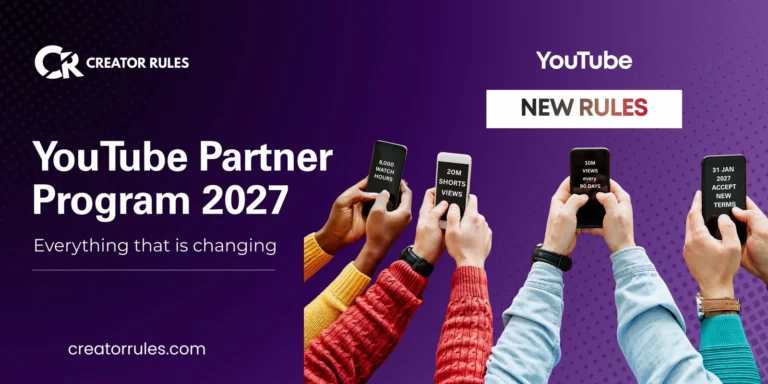
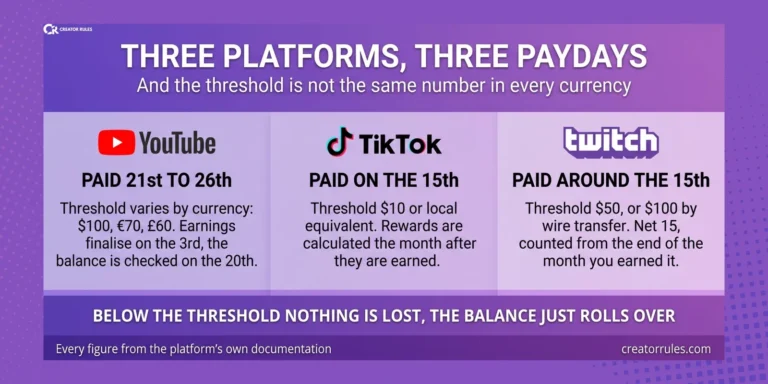
None of this applies until you are in the Partner Program, since both routes run through it. The entry thresholds, including what changes in 2027, are set out in the Partner Program requirements, and when the money actually arrives is covered in when platforms pay creators.