How Long Does It Take to Reach 8,000 Watch Hours?
Last updated: 28 August 2026. Thresholds and counting rules come from YouTube’s own documentation, linked at the bottom.
There is no honest answer in months, and anyone who gives you one is guessing. What there is, is arithmetic, and the arithmetic tells you more than a timeline would.
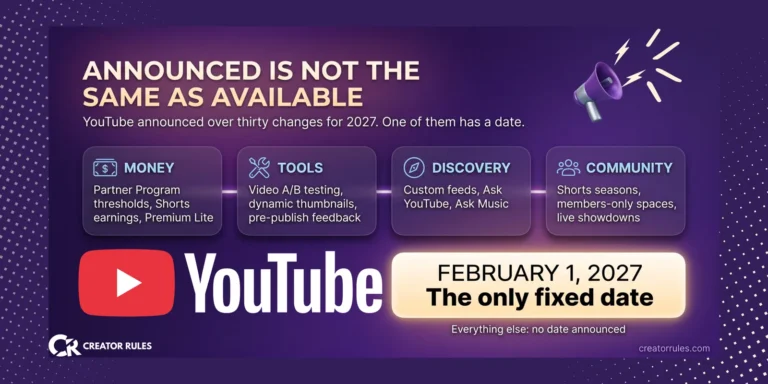
The threshold is 4,000 qualified watch hours today and 8,000 from 1 February 2027, both measured over the last 365 days. Here is what that actually asks of a channel.
Start with the real number
8,000 hours is 480,000 minutes. That figure is more useful than the hours, because watch time is measured in minutes and your analytics report it that way.
Now divide it by the window. You need 8,000 hours inside a rolling 365 days, which works out at roughly 22 hours of watch time every single day, sustained for a year. Under the current 4,000 threshold it is about 11 hours a day.
That framing kills a lot of wishful thinking. It is not a pile you slowly add to. It is a rate you have to hold.
Views is the wrong question
The first thing people ask is how many views they need. The answer depends entirely on how long your videos are and how much of them people actually watch, and the spread is enormous.
| Video length | Average viewed | Minutes per view | Views needed for 8,000 hours |
|---|---|---|---|
| 3 minutes | 60% | 1.8 | about 267,000 |
| 5 minutes | 50% | 2.5 | about 192,000 |
| 8 minutes | 45% | 3.6 | about 133,000 |
| 10 minutes | 45% | 4.5 | about 107,000 |
| 15 minutes | 40% | 6.0 | about 80,000 |
| 20 minutes | 40% | 8.0 | about 60,000 |
| 30 minutes | 35% | 10.5 | about 46,000 |
Same threshold, and the top row needs almost six times the views of the bottom row. The number that matters is not views, it is minutes watched per view, and you can find yours in YouTube Studio under Analytics as average view duration.
Take your own average view duration, multiply by your average views per video, and you have watch minutes per video. Divide 480,000 by that and you know how many videos this takes at your current performance. It is a five minute calculation and it is worth more than any general estimate.
So how long, roughly
Take a channel posting one 10 minute video a week, holding 45% average view duration, getting 2,000 views per video. That is 4.5 minutes per view, 9,000 minutes per video, 150 hours per video.
8,000 divided by 150 is roughly 53 videos. At one a week that is a year, and that is before you account for the back catalogue continuing to earn, which pulls it in.
| Uploads | Views per video | Hours per video | Rough time to 8,000 |
|---|---|---|---|
| 1 per week | 500 | 37 | Not reachable at this rate |
| 1 per week | 2,000 | 150 | About a year |
| 2 per week | 2,000 | 150 | About six months |
| 1 per week | 10,000 | 750 | Two to three months |
All of these assume 10 minute videos at 45% retention. Change the length or the retention and every row moves.
The part that catches people out
Look at the first row of that table again. One video a week at 500 views is roughly 1,900 hours a year. That channel is not slowly approaching 8,000. It is never going to get there, no matter how long it keeps going, because the window is rolling.
Hours earned 366 days ago drop out of your total. If you are generating fewer hours than are expiring, your number stops rising and starts drifting down. Plenty of channels sit at the same watch hour figure for years and assume they are making slow progress. They are treading water.
The practical test: look at your watch hours today and at the same figure three months ago. If the gap is small, more time is not the answer. Something has to change.
What actually moves it
Length, if you can hold retention. Going from 8 minute videos to 20 minute videos cuts the views you need by more than half. But only if people still watch a similar percentage. A 20 minute video watched for two minutes is worse than an 8 minute video watched for four.
The first thirty seconds. Most of the drop-off in average view duration happens at the start. Fixing the opening of your videos lifts every hour you earn afterwards, on every video.
Search-driven topics. A video answering a question people type into YouTube keeps earning watch time for years. A video about this week’s news earns for a week. For a threshold measured over a rolling year, the first kind is worth several of the second.
Your back catalogue. Every video you have already published is still adding hours today. This is why progress usually feels flat and then accelerates, and why giving up at month eight is the most expensive decision on the list.
What does not count towards it
Before you calculate anything, make sure the hours you think you have actually qualify. Only public long-form videos count. Shorts do not count towards watch hours at all, and neither do private, unlisted or deleted videos, paid ad campaigns, or livestreams that were never turned into public video on demand.
Deleting old uploads takes their hours with them, which is a common way to move backwards without noticing. The full list of what qualifies is in our page on how the monetization requirements are counted.
One thing worth checking first
If you are close to 4,000 now, the arithmetic above is less relevant than the calendar. A channel accepted into the Partner Program before 1 February 2027 enters under the current threshold. Review takes about a month, so the decision point is earlier than the date suggests. What changes on that date is covered in our page on the 2027 Partner Program changes.
Sources
- YouTube Partner Program overview & eligibility, YouTube Help
- New opportunities to earn and changes to the YouTube Partner Program, YouTube Official Blog, 10 August 2026
The tables on this page are arithmetic based on YouTube’s published thresholds, not predictions. Your own numbers will differ. Creator Rules is an independent publication and is not affiliated with YouTube or Google.