Copyright Claim vs Strike: Which One Actually Costs You Money
Two emails arrive that look almost identical. One says your video has a copyright claim on it. The other says your channel has received a copyright strike. Most creators react to both the same way, with the same panic, and that is the mistake.
They are not the same system, they do not carry the same risk, and the one people worry about most is usually the harmless one.
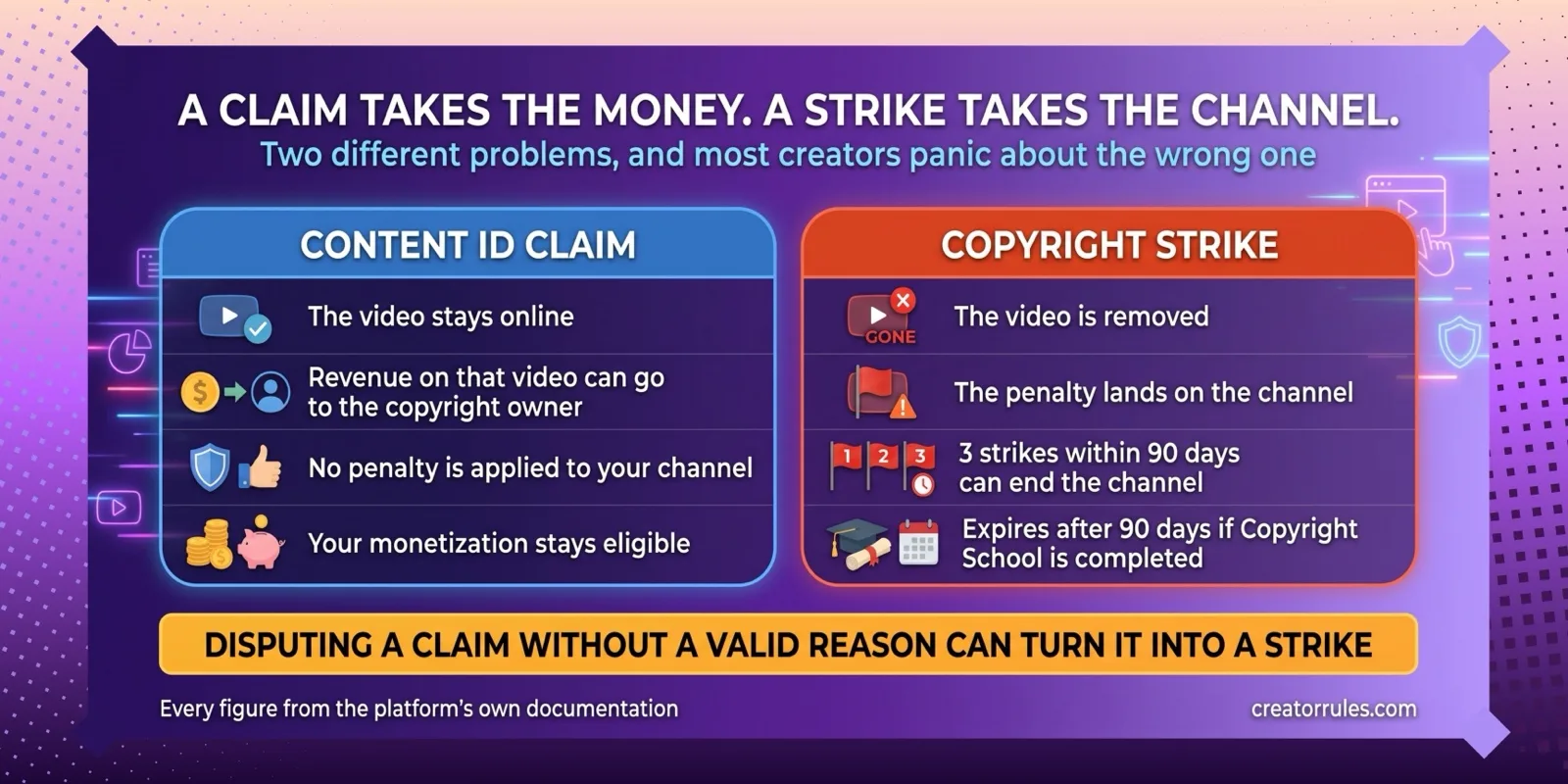
Here is the difference in a sentence. A claim takes the money on that video. A strike puts the whole channel at risk.
What a Content ID claim actually does
Content ID is automated. It matches your upload against a database of material that rights holders have registered, and when it finds a match it applies a claim to that video.
What happens next is the rights holder’s choice, not YouTube’s. They can block the video, they can monetize it by running ads on it, or they can simply track its viewership. In practice most choose to track or monetize rather than block, which is why the video usually stays up and playable.
If they choose to monetize, the advertising revenue from that video can go to them instead of you. Sometimes it is shared with the uploader. Either way, the video keeps its views and keeps its place on your channel. It just stops being worth what it would otherwise have been worth, which matters more than people realise once you understand how little of a view actually reaches you in the first place.
What a copyright strike actually does
A strike is not automated in the same way. It is the result of a legal copyright removal request submitted by the rights holder, and the consequence is different in kind, not just in degree.
The video comes down. And the penalty attaches to the channel rather than to that upload.
That is the part that matters. A claim is a problem for one video. A strike is a mark on the account that produced it.
Three strikes, and the ninety day clock that works both ways
Channels that receive three copyright strikes within ninety days are subject to termination. Not the video, the channel, along with everything on it.
The same ninety day number appears on the other side of the equation, and this is the part worth knowing when you are staring at a first strike. A strike expires ninety days after it was applied, provided you complete Copyright School and your channel has fewer than three strikes.
So a single strike is survivable and temporary, but only if you do the thing YouTube asks. Ignore Copyright School and the clock does not start.
One more distinction that catches people out: copyright strikes are counted separately from Community Guidelines strikes. They are two different systems with two different counters. A channel can be clean on one and in trouble on the other.
The trap: disputing a claim can create a strike
This is the single most important thing in this article, and almost nobody mentions it.
When you receive a Content ID claim, YouTube offers you a dispute button. It feels like the obvious thing to press. But if you dispute a claim without a valid reason, the copyright owner has the option to respond by submitting a copyright removal request instead.
At that point the thing you were trying to get rid of has become the thing you actually should have been afraid of. You started with a claim that cost you the revenue on one video. You can end up with a strike that counts against the channel.
The asymmetry is brutal. Disputing a claim you are right about gets your revenue back on one video. Disputing a claim you are wrong about can cost you a third of the way to termination.
What a claim does not do
YouTube’s own wording is that Content ID claims affect videos but usually do not impact your channel or account.
The word doing the work there is “usually”, and the exception is the one above. Left alone, a claim does not become a strike. It does not put your channel at risk, and it does not by itself affect your eligibility for the Partner Program. Strikes are a different matter, because an account in poor standing is a different kind of problem.
So if you are asking whether you are about to lose monetization, the answer depends entirely on which of the two you have received. A claim, on its own, is not that.
When it is worth disputing, and when it is not
The honest test is whether you can state your reason in one clear sentence before you click anything.
Reasons that hold up are specific. You licensed the material and can produce the licence. You own the material yourself. The claim matched the wrong thing entirely, which happens more than you would expect with background noise, royalty free music and public domain recordings.
Reasons that do not hold up are the familiar ones. You credited the creator in the description. You only used a few seconds. You are not making money from it anyway. None of these are legal defences, and each of them is a route to the outcome described above.
If the video matters to you and the claim is wrong, dispute it. If the video is old, the claim is arguably correct, and the revenue was small, the cheapest move is often to do nothing at all, or to remove the claimed section and keep the video clean.
What to check first when one arrives
Open YouTube Studio and read which of the two words you are looking at. That single reading decides everything else.
If it says claim: check what the rights holder chose. Blocked, monetized or tracked are three very different situations, and only one of them costs you anything. Then decide whether you have a reason to dispute that you could say out loud to a lawyer.
If it says strike: check the date, because the ninety day clock starts there. Complete Copyright School promptly, since the expiry depends on it. And treat the next ninety days as a period where a second and third strike carry consequences far beyond the videos involved.
What to take from this
A Content ID claim is a revenue problem on one video. It is annoying, it is often automated and imperfect, and left alone it stays exactly that size.
A copyright strike is a channel problem. Three within ninety days can end everything, and one expires after ninety days only if you complete Copyright School.
And the bridge between them is the dispute button. Pressing it with a good reason is how you get your revenue back. Pressing it without one is how a video problem becomes a channel problem.
If you want the wider picture of how platform enforcement has been tightening, our timeline of recent rule changes covers what has moved across YouTube, TikTok, Twitch and the EU in the past year.
Sources
- YouTube Help, Understand copyright strikes
- YouTube Help, Learn about Content ID claims
- YouTube Help, What is a copyright claim, the difference between copyright takedowns and Content ID claims
- YouTube Help, Appeal a Content ID claim