Can I Post the Same Video on YouTube, TikTok and Instagram?
You spent an afternoon on a video. Posting it once feels like a waste, so it goes up on all three platforms, and that is the sensible thing to do. Everyone does it.
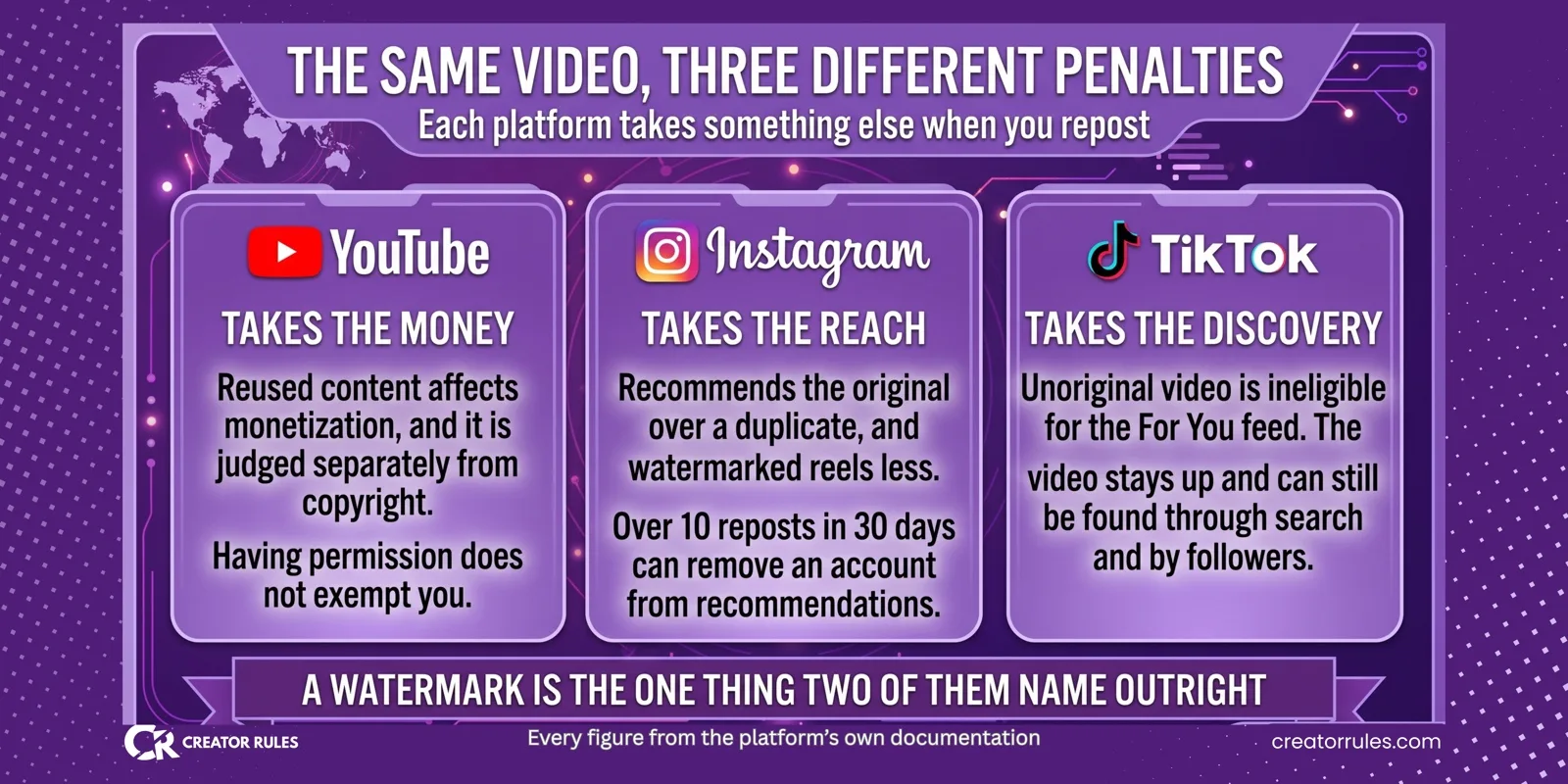
What almost nobody knows is that all three platforms have written down what they do about it, and they do not do the same thing. One takes your money, one takes your reach, one takes your discovery. Knowing which is which changes how you post rather than whether you post.
Short version: you are allowed to post the same video everywhere. What you are not allowed to do is post it in a way that makes it look imported.
YouTube takes the money
YouTube’s term is reused content, and it describes repurposing material that already exists elsewhere without adding meaningful original commentary, substantive modifications, or educational or entertainment value.
Two details matter here and both get missed. The first is that this sits inside the monetization policies, so the consequence lands on your earnings rather than on the video. The second is bigger: reused content is judged separately from copyright. Having permission, owning the footage, or being the person who filmed it does not exempt you, because the question is not whether you had the right to use it. The question is what you added.
YouTube’s own examples of what is acceptable are useful: content where the creator is visible in it, or explains what they added, or where the editing is substantive enough that the result is clearly specific to that channel. What fails is the opposite: clips assembled with little narrative, or reaction footage with no spoken commentary.
Because this is a monetization policy rather than a strike system, it is worth being clear how it differs from the other thing that costs creators revenue on YouTube, which is a copyright claim or a strike. Those are about ownership. Reused content is about contribution.
Instagram takes the reach
Instagram’s approach is the most explicit of the three, and the only one that attaches a number to it.
Its recommendation system is less likely to recommend a reel that has already been posted on Instagram, content carrying a noticeable watermark, or accounts that regularly collect and reshare other people’s material. When it finds two or more identical pieces of content, it recommends the original one. And an account that posts more than ten reposts in a thirty day period can be removed from recommendations altogether.
There is a longer list of things Instagram makes less visible, and it is worth reading as a production checklist rather than as a rulebook: low resolution, visible watermarks, muted audio, borders around the frame, and video that is mostly text. Instagram has also been testing notifications that tell a creator when a reel’s reach is limited because of a watermark, which tells you how routine the problem is.
Note what is not on that list. Nothing here affects whether you can earn on Instagram, and the monetization tools have their own conditions, which we went through in what Instagram actually pays for. This is purely about who sees the video.
TikTok takes the discovery
TikTok handles it through the For You feed eligibility standards, and the wording is direct: unoriginal and low quality content is ineligible for recommendation on the For You feed.
Unoriginal, in TikTok’s definition, is content imported or copied from other sources without new creative edits. Then comes the sentence that matters most in this whole article: a video may be unoriginal if it has a watermark or logo on it. Low quality is defined separately and covers very short videos, static images, and videos made only of GIFs.
The consequence is narrower than people assume. The video is not removed. It stays on your profile, it can be found through search, and the people who follow you can still see it. What it loses is the For You feed, which on TikTok is where nearly all reach comes from, so in practice it is the difference between a video existing and a video being seen.
This also interacts with earnings, because content that cannot be recommended is content that does not accumulate the views the Creator Rewards Program requires.
Does a TikTok watermark hurt your reach on Instagram?
Yes, and Instagram says so in its own words rather than leaving it to be inferred. Watermarked reels are recommended less, and the platform has been testing a notification to tell creators when that has happened to a specific reel.
TikTok says the same thing from the other direction: a video may be treated as unoriginal because it carries a watermark or a logo. So the watermark is not a small cosmetic issue that only matters on one platform. It is the single feature that two of the three platforms name outright, and it is the easiest of all these problems to avoid.
The fix is to never export the version with the watermark on it. Save the clean file from your editing app before it goes anywhere, and treat the platform’s own download button as the last resort rather than the normal route. Everything else in this article takes judgement. This part takes thirty seconds.
What each platform actually takes
| What it costs you | What triggers it | Does the video stay up | |
|---|---|---|---|
| YouTube | Monetization | Nothing meaningful added, judged separately from copyright | Yes |
| Reach | Duplicates, visible watermarks, more than 10 reposts in 30 days | Yes | |
| TikTok | For You feed | Imported without new edits, or carrying a watermark | Yes |
Read the last column twice. None of the three removes your video. Every one of these is a distribution or revenue decision, not an enforcement action, which is why creators so often have no idea it has happened to them. There is no notification on two of the three, and the only signal is that a video quietly did nothing.
So what actually works
Export clean, without the platform watermark, every time. That single habit resolves most of what is described above.
Then make the upload native to where it is going. Different aspect ratio, different opening seconds, captions written in that platform’s text tool rather than burned in from another one. This is not about tricking a detection system, it is what the policies are asking for in the first place: evidence that the upload was made for this audience rather than dropped in from elsewhere.
On YouTube specifically, ask what the video adds rather than where it came from. A clip with your commentary over it is a different object from the same clip posted plain, and YouTube is judging that difference, not the origin of the footage. If you are close to the thresholds and worried about your standing, it is worth knowing what actually puts monetization at risk.
And accept the thing nobody wants to hear: the same file on three platforms will always perform worse than three files made for three platforms. Posting everywhere is still worth it. Just do not expect the version you imported to travel as far as the one you made.