US Tax Withholding for Creators: The 24% Nobody Warns You About
Last updated: 7 September 2026. Every figure below comes from Google’s own AdSense and YouTube documentation, linked at the bottom.
There is a form in your AdSense account that decides how much of your money you keep. Most creators outside the US fill it in once, if at all, and never think about it again.
The cost of skipping it is up to 24 percent. And it is not taken from the part of your income you would expect.
Why the US taxes you at all
Google is a US company. When a viewer in the United States watches your video and sees an ad, that revenue is treated as US-sourced income, no matter where you live. US law requires Google to withhold tax on it and report it.
This applies to every monetizing creator outside the US. Not just large channels, and not just people who deliberately target an American audience.
The part almost everyone gets wrong
Search this topic and you will read the same sentence everywhere: “Google withholds 24 percent of your US earnings.”
That is right for one situation and badly wrong for another, and the difference is the whole point.
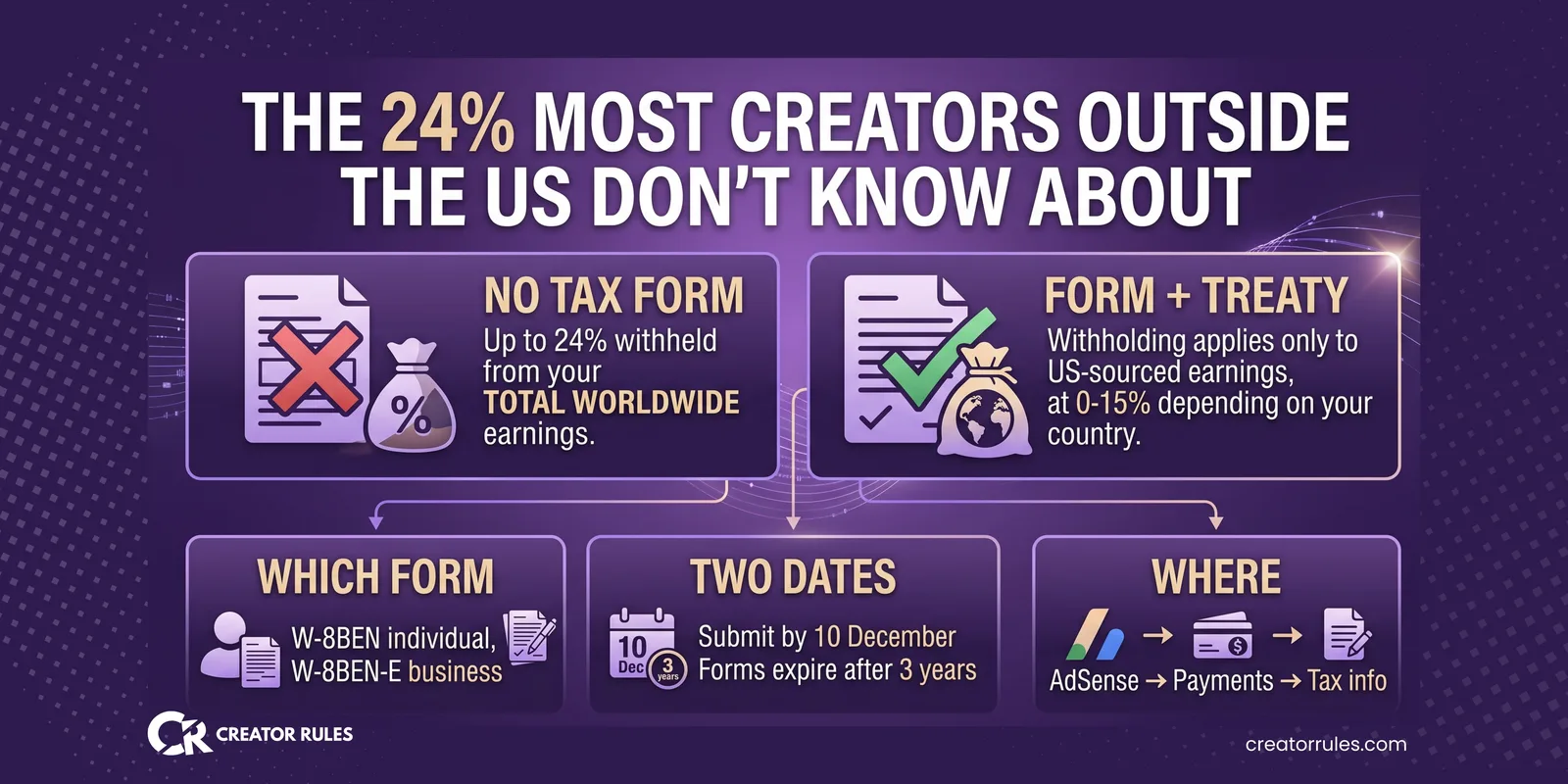
Google is only required to withhold US tax on your earnings from US viewers. But if you have not submitted tax info, Google does not know where you are or what you are entitled to. In that case it may be required to deduct up to 24 percent of your total earnings worldwide, not just the US portion.
| Your situation | What gets taxed | Rate |
|---|---|---|
| No tax form submitted | Total worldwide earnings | Up to 24% |
| Form submitted, no treaty | US-sourced earnings only | 30% |
| Form submitted, treaty claimed | US-sourced earnings only | 0% to 15% |
Look at the middle column rather than the rate. The rate on the top row is lower than the middle row, and the top row is still by far the worst outcome, because it applies to everything you earn.
This inverts the most common excuse for ignoring the form. “I barely have any American viewers, so it does not affect me” is exactly backwards. If you have few US viewers and no form on file, you are exposed on your German, Brazilian and Indian revenue too. The form is what limits the damage to the US slice.
Which form you need
You will not have to work this out yourself. AdSense asks a short series of questions and selects the form for you. It helps to know what it is choosing between.
- W-8BEN if you are paid as an individual. This is most creators.
- W-8BEN-E if your AdSense account is held by a company.
- W-9 if you are a US person. Different form, different rules, not what this article is about.
Answer as the entity that actually receives the money. If your payee name is a company, W-8BEN is the wrong form even if you are the only person in that company.
What a tax treaty actually does
Submitting the form stops the worldwide withholding. Claiming a treaty benefit is a second, separate step, and it is the one that lowers the rate.
If your country has an income tax treaty with the United States and you claim it correctly, the rate on your US-sourced earnings drops from 30 percent to somewhere between 0 and 15 percent. For royalty income, many treaty countries land at zero.
Google’s own worked example is blunt about the size of the gap. On the same earnings, a creator who claims a treaty benefit can end up with a final deduction of 15 dollars, while a creator who submits the form but is not eligible for a treaty faces the full 30 percent.
There is a condition that catches people out. To claim treaty benefits you generally need a tax identification number. That can be a US TIN or, in most cases, the tax number issued by your own country. Submit the form without one and you have stopped the worldwide withholding but not reduced the rate. You are on the middle row of the table, paying 30 percent, when you were entitled to the bottom row.
Two dates that decide whether it counts
The form is not a one-time task, and this is where most of the quiet losses happen.
10 December. Google’s guidance is to submit your tax form and claim any treaty benefit by 10 December each year. This applies to everyone, including creators who do not live in the US.
Three years. A W-8 form is not permanent. It is valid from the date you sign it until the last day of the third succeeding calendar year, unless something changes that makes the information on it wrong.
The IRS example is worth reading slowly, because “three years” is not quite what it sounds like. A form signed on 30 September 2022 stays valid through 31 December 2025. Not September 2025.
Which means, if you are reading this in 2026: anyone who signed their form during 2023 has it expiring on 31 December 2026. Nothing changed in your circumstances. You did nothing wrong. The form simply runs out, and if you do not resubmit it, you drop back to the top row of that table.
This is the single most common way creators lose money on this. There is no dramatic notification, no policy change to read about. The rate quietly goes up.
Where to do it
In AdSense, go to Payments, then payments info, then manage settings, and find United States tax info. The form is completed online. There is nothing to print, sign by hand or post.
It takes a few minutes. While you are in there, check the expiry date on the form you already have, because that is the number this article is really about.
Note that this lives in AdSense, not in YouTube Studio. Creators sometimes go looking in Studio, find nothing, and assume it does not apply to them. YouTube monetization runs on an AdSense account, and having one active AdSense account is itself a condition of the Partner Program.
This is the Google version. Other platforms have their own
Everything above describes the process for AdSense, which covers YouTube and Google ad revenue. The underlying rule is US tax law rather than Google policy, so it applies wherever a US company pays you. But each platform collects the form in its own place, and completing one does nothing for the others.
On Twitch, for example, tax information goes through Amazon Tax Central rather than Google. You complete it in the Creator Dashboard under Settings, then Revenue, then Payouts, then Tax Interview. The default rate without a completed interview is 30 percent, a treaty can reduce it, and the same three year expiry applies.
If you earn on more than one platform, you have more than one form to keep alive. That is the part people miss when they remember doing this once, years ago, on one of them.
What this is not
Two things get mixed into this topic and confuse the search results.
This is not backup withholding. Backup withholding is also 24 percent, which is why the two get merged online, but it applies to US persons who did not give a correct taxpayer number on a W-9. Advice written for that situation, including the advice to file a US tax return and claim the money back, does not transfer to a creator in Portugal or Germany.
And it is not your income tax. Withholding is tax paid to the US at source. What you owe in your own country is a separate question, and depending on your treaty you may be able to credit the amount withheld against it. That part is worth an accountant rather than an article.
The short version
Submit the form, claim the treaty, include your tax number, and check the expiry date once a year.
Skipping the form does not protect a small US audience from tax. It exposes the rest of your income to it. And the creators who lose the most on this are usually not the ones who never filled it in. They are the ones who filled it in correctly three years ago and never looked again.
Sources
- Google AdSense Help: Submit your non-US tax info to Google
- YouTube Help: US tax requirements for YouTube earnings
- YouTube Help: Submitting your US tax info to Google
- IRS: Instructions for Form W-8BEN
This is general information about how Google’s withholding works, not tax advice. Rules change and individual circumstances differ, so check the official pages linked above and speak to a professional about your own situation.